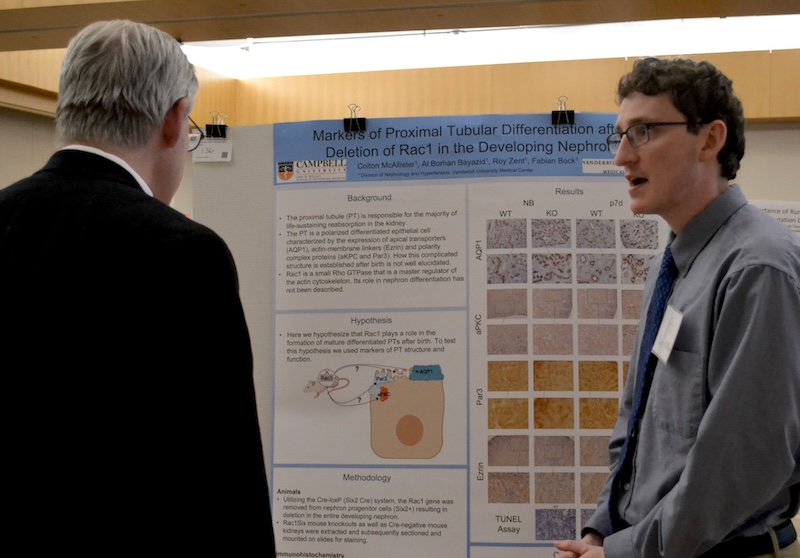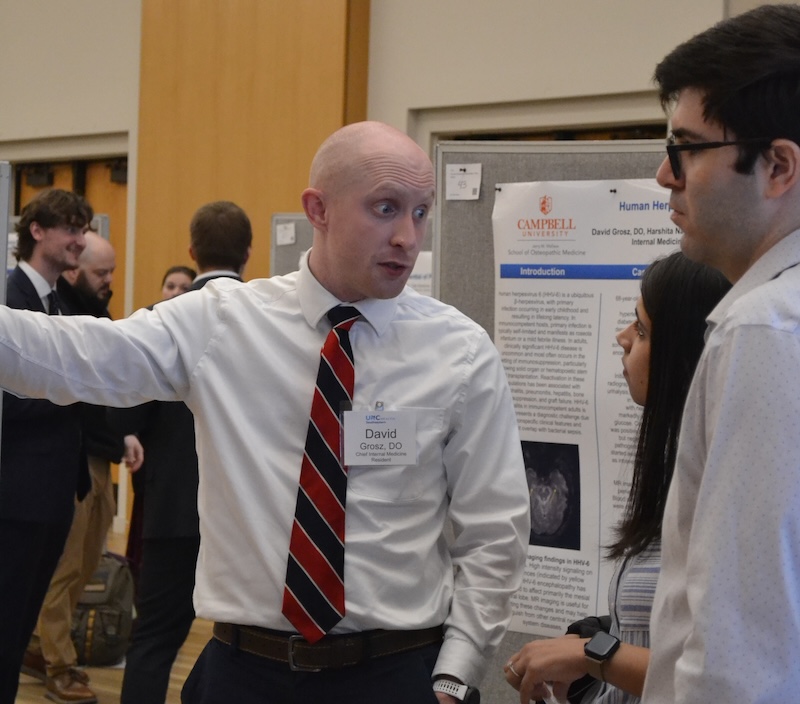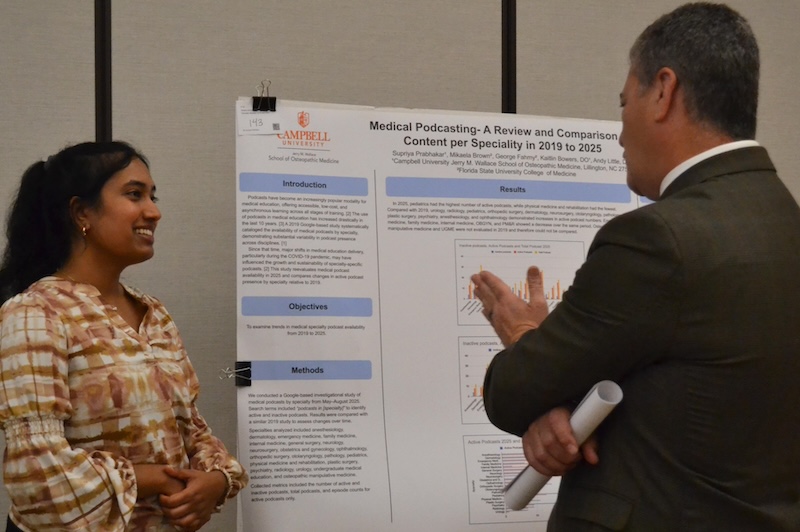

Students in the Jerry M. Wallace School of Osteopathic Medicine (CUSOM), as well as residents and fellows serving at Campbell University affiliated sites, presented their research work recently as part of the 9th C.U.R.R.E. Symposium.
The Campbell University Regional Research and Educational Symposium and friendly competition — which was held virtually and in-person — brought together a diverse array of exceptional physicians, faculty, staff and students representing the Campbell University medical school and its health partners.
The event was held Feb. 6 in the student union on campus and on the Fourwaves event platform online. All 132 research posters were housed in digital format, and at least half of the attendees watched online.
Dr. James West, the designated institutional official for the sponsoring institution, offered opening remarks. West thanked Tydal Jackson, CUSOM coordinator of Graduate Medical Education, and Dr. Terri Hamrick, associate dean for Research, for their “painstaking efforts” in coordinating the event.
“This is a truly wonderful opportunity for us to bring members of the CUSOM family from across the region — spanning much of North Carolina and our affiliates located on the Coastal regions of South Carolina — together to share their hard work and dedicated efforts to improve the health of the communities they serve,” West said.
C.U.R.R.E. is intended to promote collegiality and create an environment of scholarly inquiry among all Campbell-sponsored Graduate Medical Education (GME) programs and university-affiliated graduate medical education sites.
It, too, is an academic competition.
Hospital systems represented at the symposium were Cape Fear Valley Health, UNC Health Southeastern, Harnett Health, Sampson Regional Medical Center, Iredell Health System and Conway Medical Center in South Carolina, as well as the North Carolina Osteopathic Medical Association (NCOMA), a co-sponsor of the event, with Campbell.
The research, broken into categories, is judged, and prizes are awarded after a presentation culminating the event. Judges representing Campbell and the region GME sites pored over the 132 research abstracts — many based on actual cases — which were broken into categories, and prizes were awarded after a presentation culminating the event.
Presented posters included a quality parameter — what was learned — and assigned to one of the following CMS categories: Mortality, Readmissions, Safety of Care, Patient Experience, Effectiveness of Care, Timeliness of Care, Efficient Use of Medical Imaging/Testing, Emerging Medical Care/Diagnosis and Academic Medicine.
The student doctors, residents and fellows showcased their work through an intricate display of charts, graphs and findings, presented on large posters and focusing on topics, such as “Aligning Medical Resident Salaries with Inflation to Improve Program Perception and Retention,” “Adolescent E-Cigarette Use: Exploring Risk Factors, Mental Health Implications, and Prevention Strategies” and “Case Report of Breast Cancer with Liver Metastasis.”
The annual symposium also helps bring new excitement to the practice of osteopathic medicine.
Today, the American Osteopathic Association says, the osteopathic medical profession represents about 11 percent of all physicians and more than 25% of all medical students in the U.S. More prospective physicians than ever are choosing to become DOs, with nearly 40,000 medical students attending 44 colleges of osteopathic medicine across 71 campuses. DOs hold some of the most distinguished positions in medicine today, caring for the U.S. president, overseeing the NASA medical team and leading some of the nation’s top-ranked hospitals and health systems. About 38 percent of military physicians are DOs, says the AOA.
The mission of CUSOM, West said, is to educate and prepare community-based osteopathic physicians — in a Christian environment — to care for rural and underserved populations in North Carolina, the Southeast and the nation.
This, West said, coincides with the university mission, which, in part, is to provide graduates with professional skills who are prepared to live purposeful lives and provide meaningful service.
Symposium entries are listed here.