
They were just waiting for a little help, which came from a group of high school students learning more about the medical school, about medicine and a possible career in healthcare.
 The high school students, too, were ready for surgery. They would play a vital role.
“We’re having them actually help out and stop the bleed in the aorta,” said Sullivan, a third-year student in the Jerry M. Wallace School of Osteopathic Medicine.
“They’re starting by ‘gowning’ and gloving, putting all the equipment on, and then coming over and helping out,” said Reynolds, also in her third year at the med school.
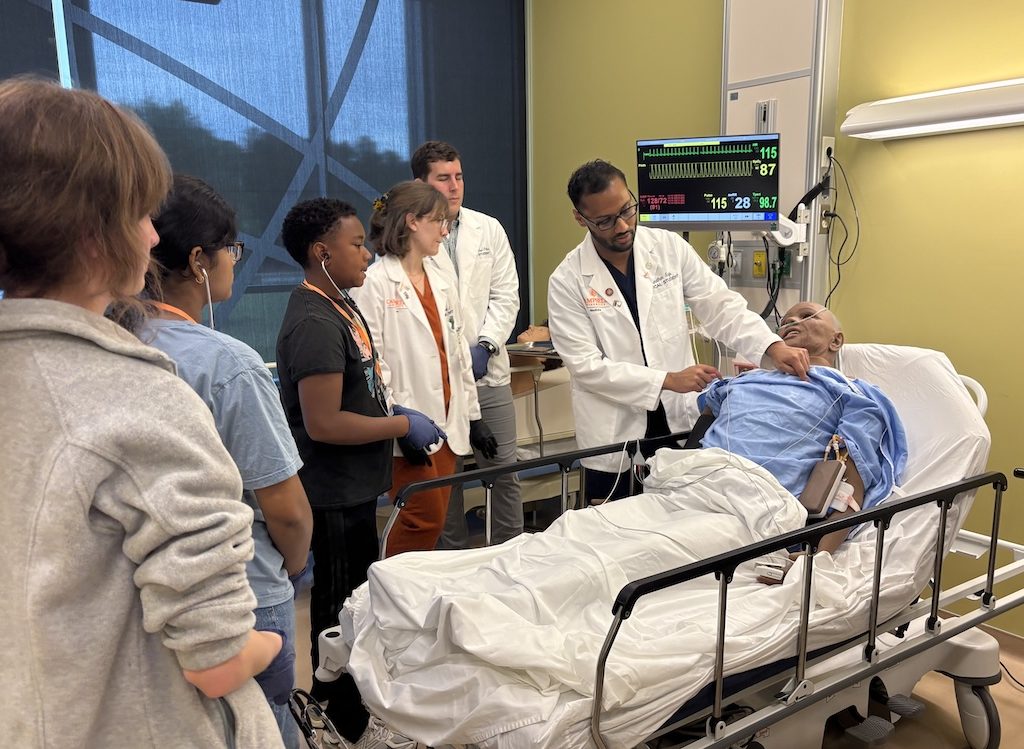
The “patient,” a realistic manikin set up for the surgery, was one tool in an array of medical simulations as part of the White Coat Workshop Pre-Health SIMposium on June 26 on the Health Sciences campus.
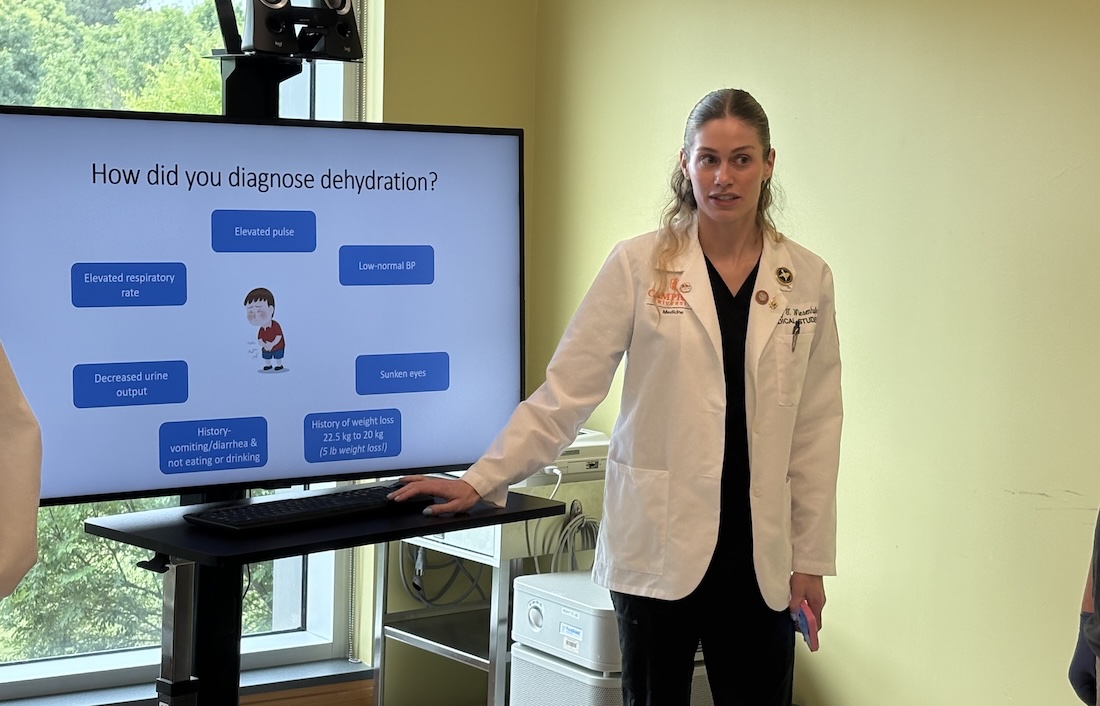
In another room at the med school’s SIM center, a small patient was suffering from dehydration, and a team of physicians was treating him.
Student Dr. Haley Wiesenhofer, surrounded by a group of high schoolers and fellow med students, pointed toward a board outlining details of the condition. What clues to look for, how to treat the patient and the different roles of healthcare providers working on the case.
More than 70 students, ninth- to 12-graders representing high schools throughout Eastern North Carolina, visited Campbell as part of the day-long camp. Students learned about what it takes to become a doctor of osteopathic medicine. High schoolers walked from station to station at the med school, learning about pediatrics, ultrasound technology, osteopathic manipulative medicine and intubation, for example.
They also spent time in nearby Smith Hall, learning about the roles of physician assistants, nurses, physical therapists and pharmacists.
Student Dr. Caroline Nowell doesn’t remember taking part in a medical day camp like this one, but she appreciates the experience.
“I’m having a good time,” she said. “This is a very real example. It’s a really cool opportunity for high schoolers.”
It’s also a chance for med students to practice and enhance their teaching skills, med school Dean Dr. David Tolentino said.
“What stands out most is watching our osteopathic medical students teach with confidence and enthusiasm while helping younger students imagine themselves in healthcare,” Tolentino said. “Experiences like this show how powerful hands-on learning can be, and how we’re building the next generation while serving our communities.”
High school sophomores Nella Barefoot, of Fuquay-Varina, and Chandler Castle, of Clayton, talked about their experiences while waiting in line for lunch. Castle, of Clayton, learned about delivering a baby.
They, too, talked about Anatomage, an interactive 3D virtual dissection technology used for medical education. It is most widely known for the Anatomage Table, a life-sized, touch-sensitive screen that allows students to view, rotate and “dissect” fully functional, digitized human cadavers, according to the National Institutes of Health.
“That was really cool,” Barefoot said. “We got to learn (about) the muscles and the nerves. We got to do a pain simulator … and we learned how to (insert) an IV.”
“It’s been a great day,” said Dusty Barbour, technical director of the med school’s Sim Center who helped to organize the event.
The third-year med students who taught the high-schoolers will begin their first clinical rotations in a couple of weeks.
“Seeing our students together, teaching high school students, and having fun doing it, has been probably the best part of the day,” Barbour said. “I think that’s why I enjoy the experience so much; seeing our students teach what they’ve learned and giving their knowledge back to those (high school) students.”