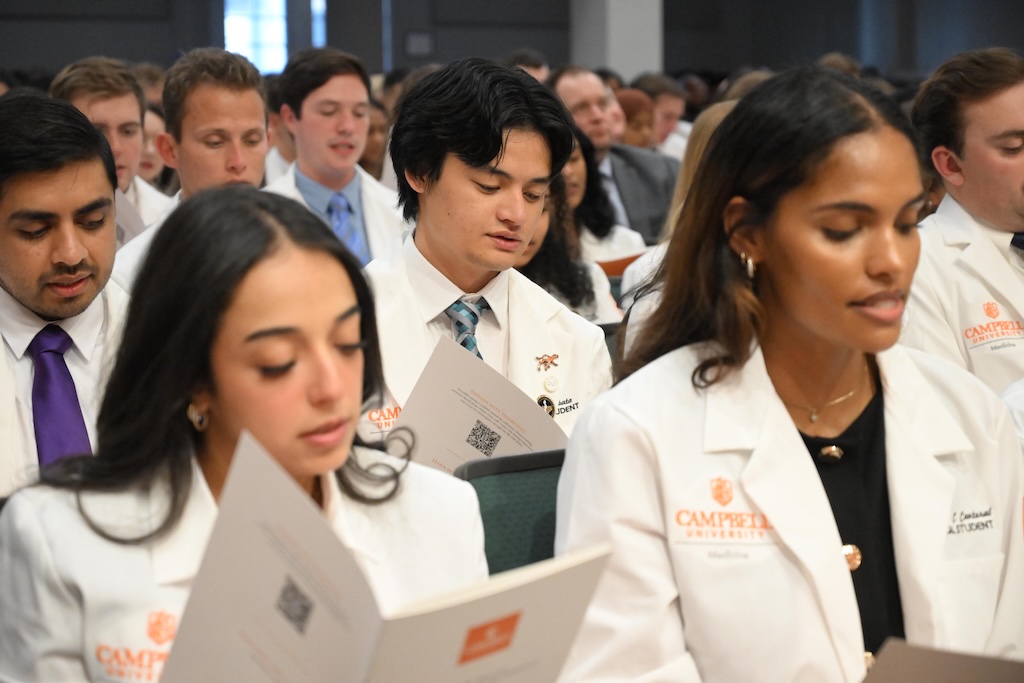
Look beyond yourself, Dr. Daniel Moses told a new group of new student doctors. Don’t allow the demands of medical school to become an excuse not to.
Make room for something, beyond the daily demands of learning, that matters to you, said Moses, a founder of the Campbell University Community Care Clinic.
“That’s what I learned here at Campbell,” he said. “It’s a lesson I carry with me today. Medical school doesn’t just teach medicine; it helps shape the kind of person that you’re going to become. You can choose to be someone who waits for opportunities, or someone who creates them.”
How can you make things better?
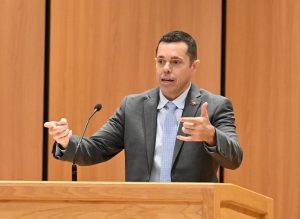
Moses, a member of the first graduating class of Campbell’s medical school in 2017, offered the White Coat address for first-year medical students in a ceremony Oct. 23 in Hobson Performance Center.
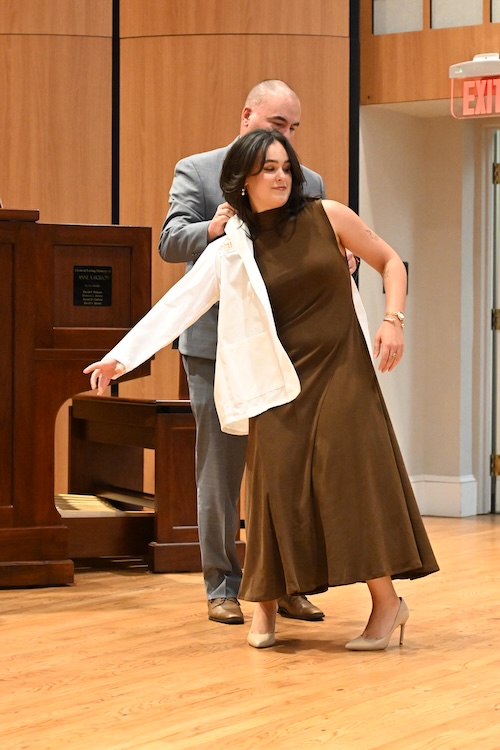
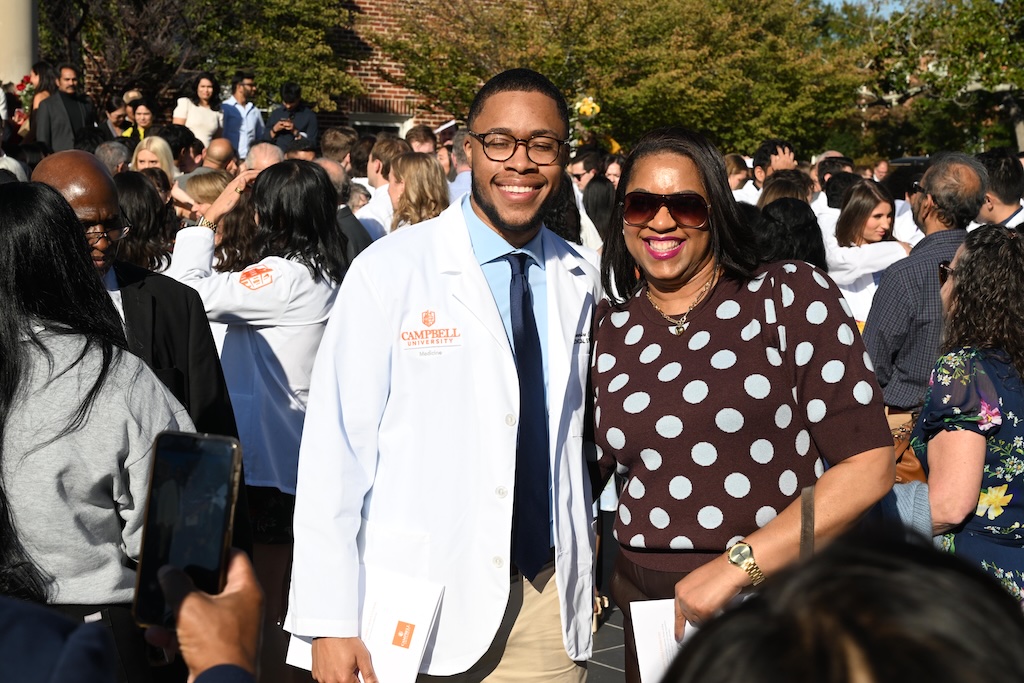
The Class of 2030 White Coat Ceremony marks a rite of passage for first-year med students as, toward the end of the ceremony, each member of the incoming class officially dons their coats. The medical school, which seated its first class in 2013, celebrated its 10th graduating class in July.
As part of the ceremony, Dr. Heather Weber, director of Clinical Education at the med school, explained the history of the white coat, including its evolution and the meaning of the clinicians’ uniform.
The white coat worn by physicians and medical professionals is a symbol of friendliness, purity and righteousness. Its symbolic origins date to the advent of aseptic surgery, in the late 1800s. The white coat ceremony is held at more than 100 medical schools across the country. As the medical profession began associating itself with science, which was earning the public’s interest and trust, by 1920 the white coat had become a powerful and iconic symbol of the physician as a medical scientist.
A board-certified family physician, Moses is assistant director of Clinical Sciences of Roseman University College of Medicine and a member of that school’s founding faculty. He’s an educator and an advocate for underserved communities, which speaks directly to the mission of the Jerry M Wallace School of Osteopathic Medicine (CUSOM).
Since graduating from Campbell, Moses has garnered many honors, his bio says, including the American College of Osteopathic Family Physicians National Osteopathic Medical Student of the Year Award and the National Health Service Corps Student-to-Service Award. Moses also leads initiatives in street medicine, service-learning and community outreach, helping medical students engage directly with individuals experiencing homelessness and other vulnerable populations.
As a member of that first CUSOM class, Moses was among a group of student doctors without the advantage of a proceeding cohort. Learning, exploring, finding its way.
“My hope is that you’re not going to just keep your head down, keep your head in the books and just move through so you get to the next thing,” Moses said. “My hope is that you will lift your eyes, look around and see the people sitting next to you, see the community outside of these walls, the opportunities that don’t appear on a course schedule.”
During his time at CUSOM, Moses helped to organize fundraisers, attended conferences and traveled on medical missions, to places such as Nicaragua.
“I was trying things. Some worked, some didn’t. I just had to be willing to participate, and most importantly, to care enough about something to do something about it.
“This community, our community, right outside these walls, needed help. They needed care. We had students who wanted to help. We had community members and faculty who were willing to support us. We had an opportunity, I think a responsibility, to bring those things together.
Talk about the mission, yes. But, Moses told the student doctors, live it, too.
“We weren’t building that thing for ourselves. We were building it for this community. We weren’t building it for us. We were building it for the students that came after us, which is all of you. So many years later, it still serves people.”
Others who spoke during the ceremony included Faithe Beam, vice president for Student Life and Christian mission; and Janavi Mehta, CUSOM class of 2029 president. William Herman, class of 2029, offered the invocation, Dr. Christopher Fink offered the osteopathic prayer, and Dr. Marta Bringhurst, chair of Osteopathic Manipulative Medicine, cited the Osteopathic Pledge of Commitment.
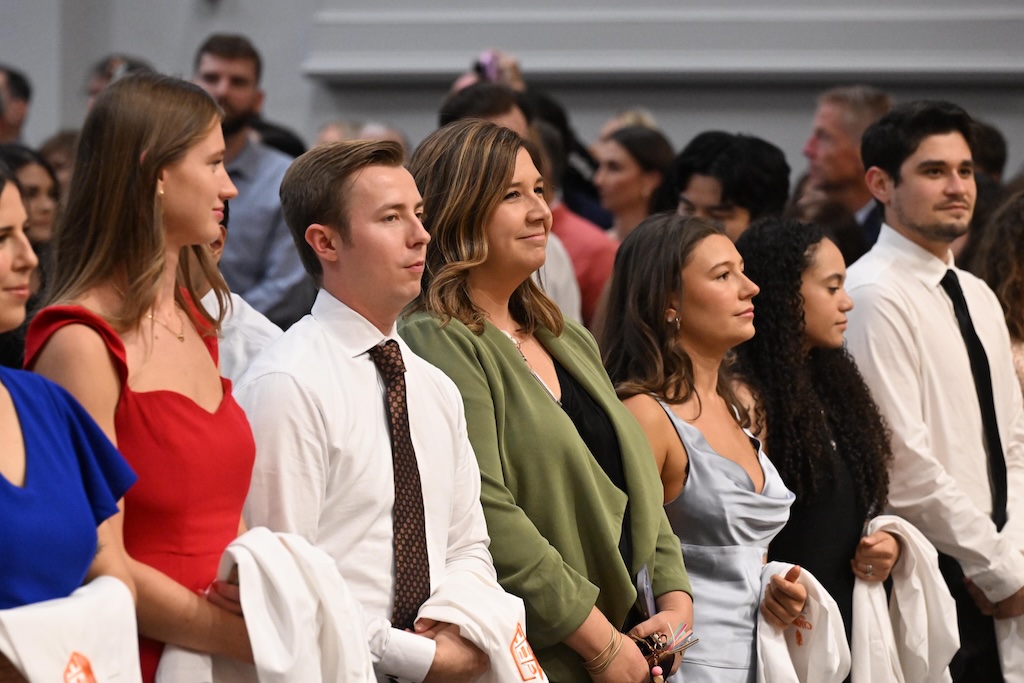
CUSOM Dean Dr. David Tolentino introduced Moses and welcomed the students’ families and friends, saying the white coat event is a celebration for them, as well. He also recognized Dr. Jerry M. Wallace, a former Campbell University president for whom the medical school is named.
“His belief in Campbell University and its ability to prepare osteopathic physicians to serve rural and underserved North Carolina continues to guide our work.” Tolentino said of Wallace. “Today,” Tolentino said to the new student doctors, “gives you an opportunity to pause, appreciate how far you have come, and remember why you should take this call.”
Tolentino reflected on the class of 2030 motto: Learn. Serve. DO.
“Your motto reminds you that you are becoming a (doctor of osteopathic medicine), and that begins with what you do for others, even now.”
He also referred to the motto when introducing Moses, who, said Tolentino, offers a meaningful example of what those words can look like in practice. “He has carried the lessons and mission of CUSOM into the communities he serves, and now helps another generation of medical students find their own call to service.”
Moses said, “You don’t have to have everything figured out. You don’t have to be particularly confident that your ideas will work. You just have to care enough to try, and be humble enough to let other people help you along the way.”