

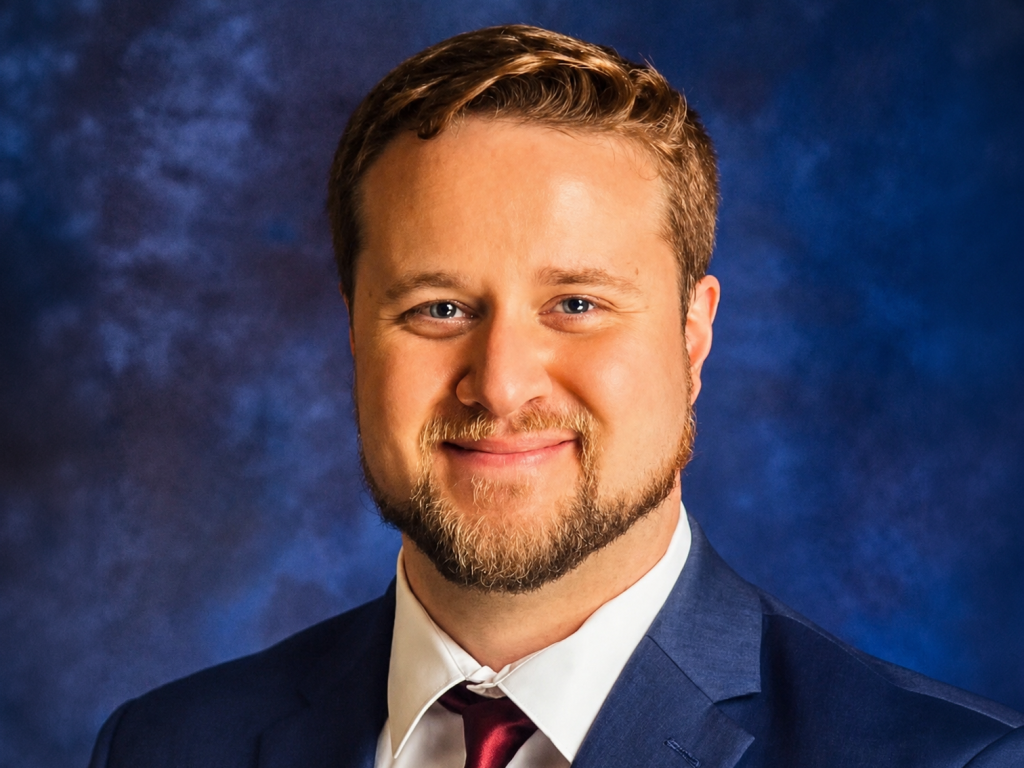

Dr. Samuel Faulkner, a 2013 Campbell University graduate, licensed psychologist a nationally certified school psychologist, will be the featured speaker at the annual Paris Lecture on Feb. 8 at the Oscar N. Harris Student Union.
The title of his talk will be, “Faster Than the Evidence: What AI Is Already Doing in Mental Health.”
Faulkner — whose work sits at the intersection of crisis care, school mental health,and the ethics of artificial intelligence — is clinical Director of the NEST Clinic, a school-integrated psychiatric clinic offering outpatient and partial hospitalization services. He designed and launched the clinic through the Central Susquehanna Intermediate Unit in Pennsylvania.
Previously, he held directorships at Geisinger, where he directed the Pediatric Bridge Clinic and led pediatric behavioral health consultation across multiple emergency departments and a children’s hospital. He also served as assistant professor of psychiatry at Geisinger Commonwealth School of Medicine.
Faulkner’s current work focuses on how AI tools respond to people in crisis, including safety protocol design and research on evaluating crisis response in AI systems.
He earned his Bachelor of Science in Psychology from Campbell in 2013 and his Ph.D. in Health Psychology, with a concentration in pediatric school psychology, from East Carolina University. Campbell named him Distinguished Alumnus in Psychology in 2021. He is the founder of Dr. Sam’s Solutions, LLC.
According to Faulkner, artificial intelligence has entered mental health care faster than the evidence behind it. It is writing clinical notes, screening for risk, triaging patients and answering people at 2 a.m. when no one else is awake.
Most of it has arrived without the kind of testing we would demand of any other intervention, he says. His lecture looks at what the research actually supports, where the tools we study and the tools people use have come apart, how these systems fail and the ethical questions the field has not yet answered. He said students and faculty across disciplines will leave with better questions to ask of the tools already moving into this work, and a clearer sense of why frontline clinical judgment is the missing voice in how they get built.
The Paris Lecture Series is made possible through a gift from Dr. John Viehe, who has taught at Campbell for many years after a distinguished career in military intelligence. The lecture series is in honor of his mother, Ethel Paris Viehe, and aunts, Florence Edith Paris and Cora Paris Hagen.
Learn more: https://education.campbell.edu/paris-lecture-series/