

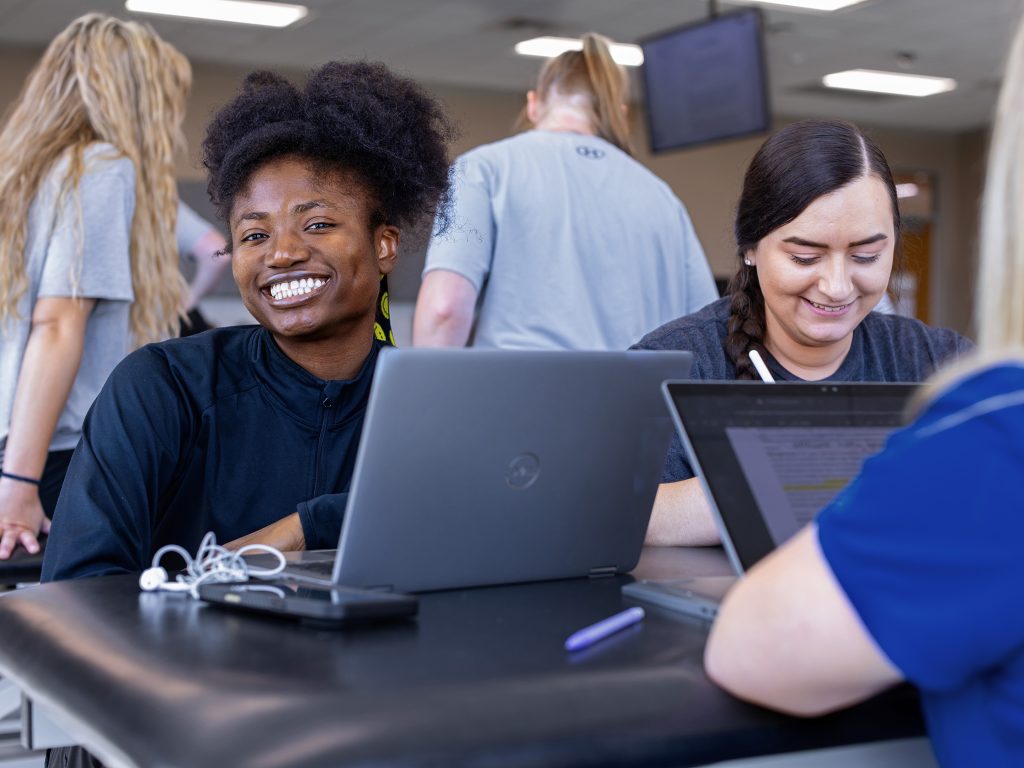

Crystal Lopez-Alvarez was 9 when her family moved back to North Carolina after spending the previous five years in Mexico. She was still learning English when she first learned about early college — an opportunity to get a high school diploma and earn two years worth of college credits along the way.
“I remember it was recess, and some students came to talk to us about it,” she said. “That was the first time I really heard the word ‘college’ in that sense, and it was the first time I thought it could be part of my future.”
She graduated from Career Technical Leadership Academy in Smithfield with an associate’s degree and got accepted to three four-year schools (and a waiting list for Harvard). She chose Campbell University, because she fell in love with the community and because of its programs that she said have prepared her for medical school
Upon enrollment. Lopez-Alvarez became the first in her family to attend college.
The now soon-to-be Campbell graduate — she’s set to walk the stage in December (debt-free, she proudly proclaims, thanks to a bevy of scholarships) — is already giving back to her school as former president of the Campbell Hispanic Association and co-founder of the First-Generation Camels Club.
She joined other first-gen students in the Academic Circle on Wednesday for the third-annual First Generation College Student Celebration, honoring not just students but also faculty and staff members who were the first in their families to earn a college degree.
Lopez-Alvarez manned one of several tables that included information for first-gen students (tips and statistics), games, prizes, food and more. Small signs with statistics like “22.9 percent of Campbell students are first-generation” lined the walkways heading into the Oscar N. Harris Student Union, and inside, posters featuring inspirational quotes from first-gen Campbell students were on display in the lobby.
Wednesday’s event was organized by the First-Generation Camels Club and Director of New Student Programs Katy Jones, who said it’s important for schools like Campbell to recognize and advocate for first-generation students from Day 1.
“I’m in charge of the CUFS 100 program [a first-year seminar course that introduces new students to college life], and I have to assume that every student is a first-generation student and doesn’t know a single thing about the college experience,” Jones said. “For example, when I started, I remember an academic success session that kept telling students, ‘check the syllabus, check the syllabus,’ and I turned to someone and asked, ‘When do they tell them what a syllabus is?’ Are we explaining these things? Are we assuming our students know these things when they get here?”
First-generation students make up more than a third of all U.S. undergraduates, and a large portion of them are minority students from low-income backgrounds. They graduate with a bachelor’s degree at a rate of roughly 40 percent, compared to 56 to 59 percent for their peers whose parents or grandparents have a degree. Only 27 percent of first-generation students complete their degree in four years.
The reasons for the lower completion rates are many — first-generation students face unique financial, academic and psychological hurdles as they navigate their college journeys, often without parental guidance. This frequently leads to intense feelings of “imposter syndrome,” Jones said, as well as social isolation.
“I hear a lot from my students — they’re afraid to ask for help, because they either don’t know what specifically to ask for or they’re afraid of looking unintelligent or unprepared,” Jones said. “That’s why it’s important to have these conversations and tell them — you’re not an imposter, and you deserve to be here.”
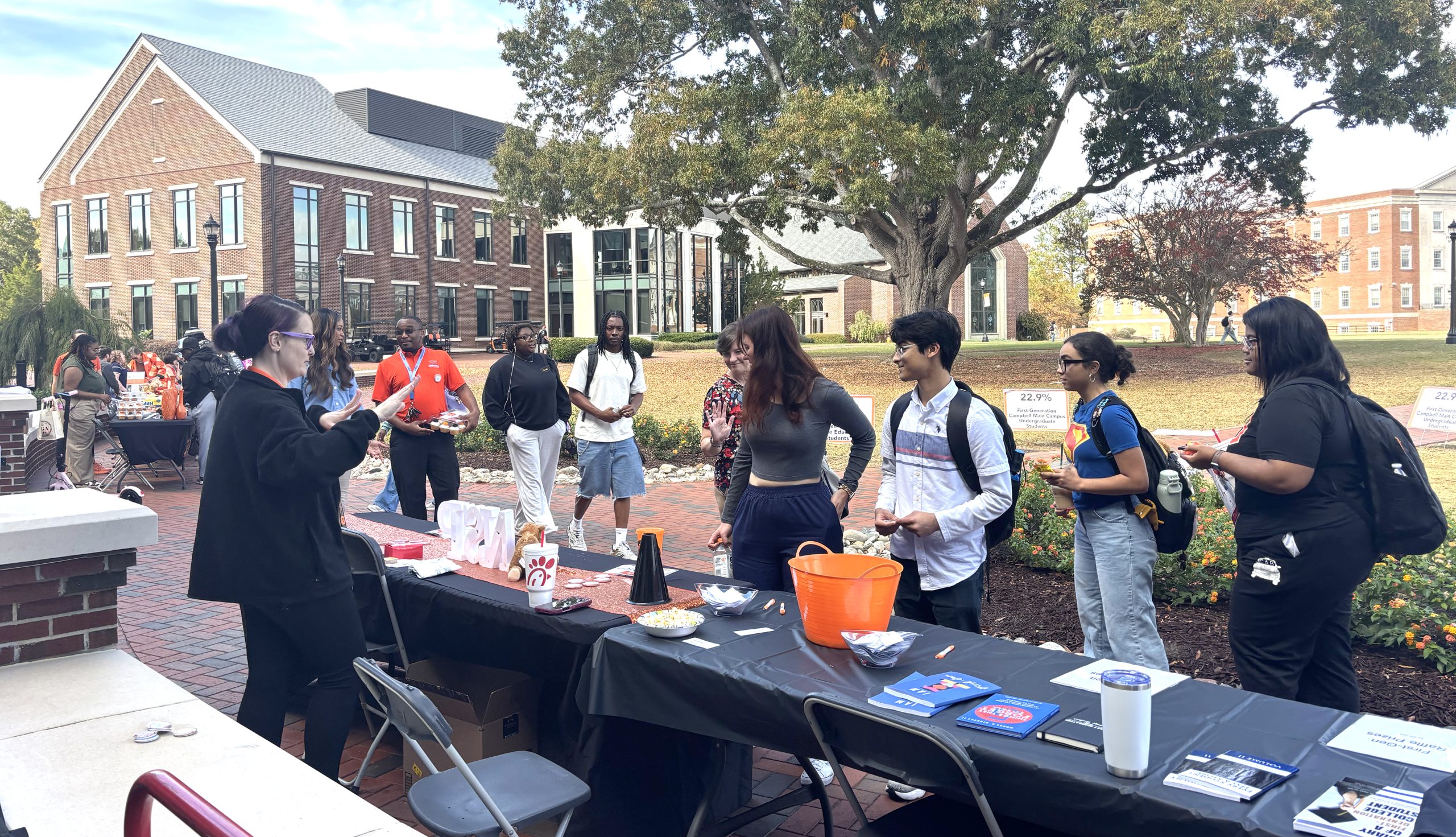
Jones was handing out “I am first!” buttons on Wednesday, as well as placards for faculty and staff to put in their office stating that they were also first-generation students. Students might feel more comfortable talking to someone with a shared experience, she said.
“My mom was an English professor, so I knew what a college campus was. I knew about residence halls, and I knew what a syllabus was,” she said. “Not only are our first-gen students learning this from the first time, but they also have to then go and re-teach their families. They are more likely to be working or supporting family in ways that maybe a traditional undergraduate student wouldn’t think about.”
Lopez-Alvarez said her early college experience helped prepare her for Campbell. For example, they used Blackboard (a digital learning management system that allows students to access assignments, view grades and submit coursework) in high school, which helped her transition to Campbell, which also uses that program.
Her advice for Campbell’s next cohort of first-generation students — find your voice.
“I think there is nothing better than being uniquely yourself, because that’s what’s going to make you shine,” she said. “As first-gens, we sometimes want to follow others because we feel lost. But there’s power in finding who we are and how we can shine in our own self. And I think that’s uniquely beautiful, because it’s like we’re adding to the community instead of feeling like we’re being taken care of.”
Riley Parker, a junior history major from Beulaville, North Carolina, said she was always encouraged by her parents to attend college, but there were always questions of affordability. Parker worked hard to earn several scholarships — including merit-based scholarships tied to her high school GPA — to make going continuing her education possible.
She chose Campbell because she said she connected with its people — both her fellow students and the professors who “genuinely want to help you succeed.”
“For me, that was one of the big draws, especially as a first-generation student, because my parents couldn’t help me figure out what college life was like,” she said. “But everybody here, you’re not just a number. Here, you’re a person to them, and they want to see you succeed. And if they don’t know how to help you, they’ll find someone who can help you.”
A self-described “homebody,” Parker said her biggest transition to college was becoming more social and getting to know people from different backgrounds.
“I didn’t realize how many people from the city were here. Talking with my friends about the differences between my rural first gen experience versus their parents with master’s degrees, we just had very, very different experiences,” she said. “But I’ve been able to learn from it. It’s opened my eyes, and it’s made this experience better.”
Parker said she’s also learned how to ask for help.
“I got here on my own, and I thought I needed to get through it on my own, too,” she said. “I thought that’s what I had to live up to. It’s very clear now that I didn’t need to do it on my own, and I had support from people who were encouraging and ready to help.”