

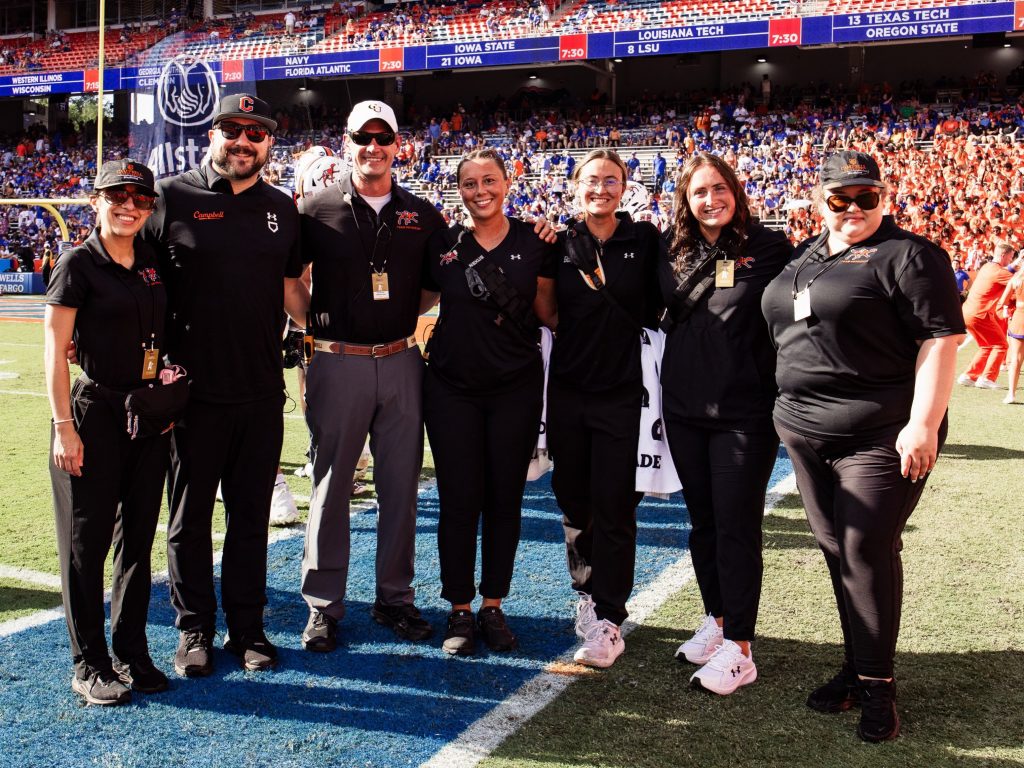

Head trainer Chelsea Beers, physical therapy professor Dr. Randall Lazicki part of team that keeps Campbell’s nationally ranked program healthy
When a program is enjoying a historic winning season, the joy is palpable for the players and coaching staff.
And for the nationally ranked Campbell Fighting Camels football program — currently 8-2 and in the race for its first Coastal Athletic Association championship and FCS playoff berth — winning makes the jobs of the athletic trainers and medical staff all the more enjoyable as well.
“The wins and losses hit us, too,” says Chelsea Beers, who joined the staff as an assistant athletic trainer in 2024 before being promoted to head trainer later that year. “So much of our job deals with being hands-on with these players and building relationships with them, so when they win, we see their joy up close.”
Beers helps lead a team of sports medicine and performance professionals who keep the 16th-ranked Camels healthy throughout the long season — from spring football to the November playoff chase. She works with Director of Football Sports Performance Trevor Kana; Athletic Trainer Lexi Deguzman; Dr. Randall Lazicki, assistant professor of physical therapy with two decades of experience optimizing human performance and rehabilitation across military and athletic populations; and a small group of team doctors.
Prior to coming to Campbell, Beers was an athletic trainer at Houston Christian University while then-head coach Braxton Harris led that program to its first winning season in 2023. She joined Harris when he took the head coach job at Campbell, where he served as an assistant in 2021-2022. Beers says she built a strong working relationship with Harris in Houston — one built on trust, respect and transparent communication … each crucial when tough decisions on injuries and whether and athlete can compete are made.
“It was an easy decision to come here,” she says. “I’ve worked with several different coaches, and when there’s a level of respect, it makes our jobs easier.”
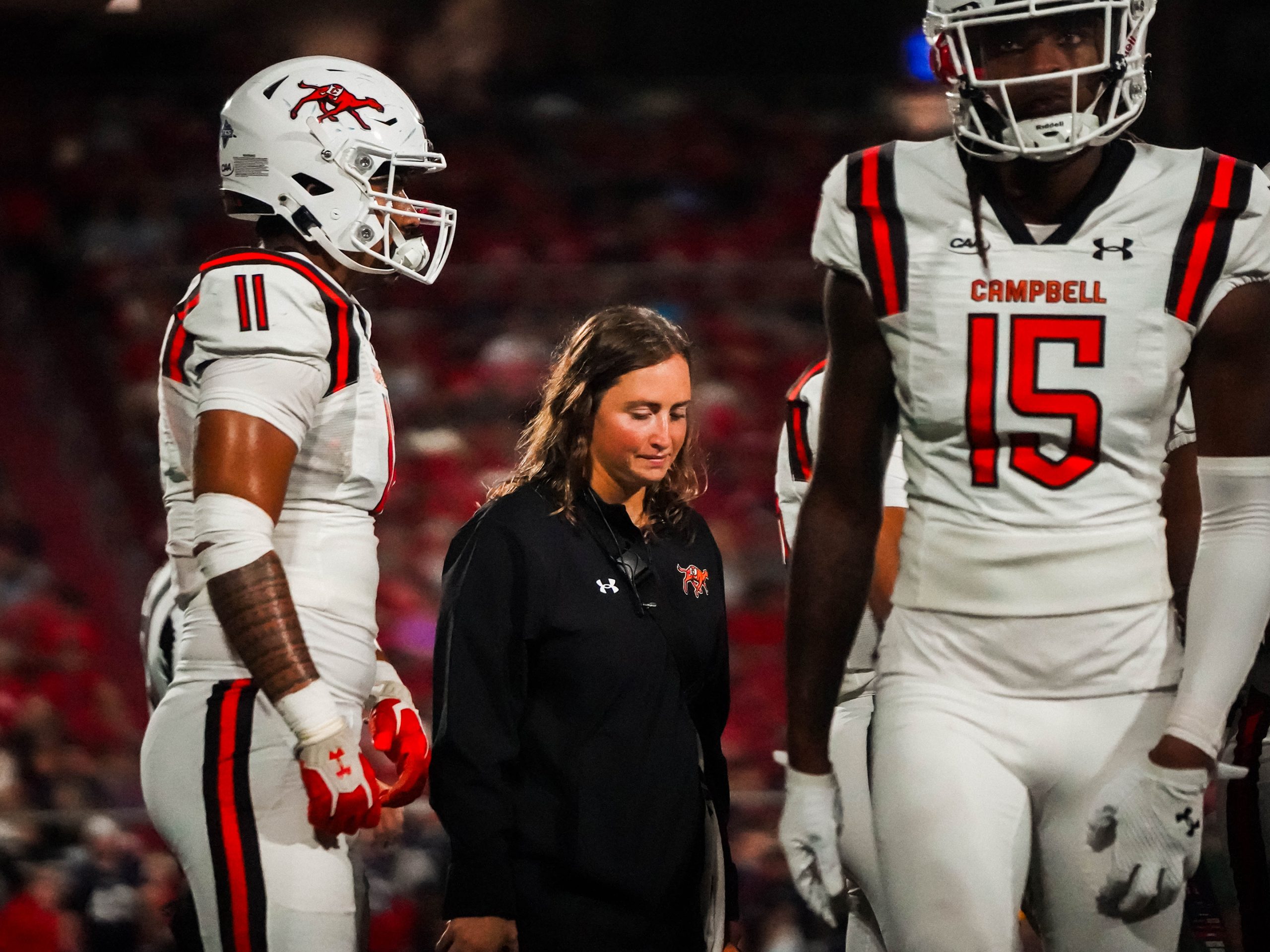
A native of Indiana and a die-hard Notre Dame football fan growing up, Beers said she was interested in a career as a physical therapist while an undergrad at Western Kentucky University. But her love of sports drew her to athletic training, and she landed internships at Western Kentucky, Olivet Nazarene and Indiana State before landing the gig at Houston Christian.
As head athletic trainer, Beers coordinates with the program’s strength and conditioning staff to create programs for injured athletes, as well as with on-campus counselors for team-wide mental health education. She also communicates with team physicians and implements rehabilitation protocols in addition to overseeing the program’s athletic training staff, including students.
She calls athletic training — particularly during the football season — a seven-day-a-week, 12-hour-a-day job that begins on Sundays with postgame rehab and ends on gamedays.
“We don’t just treat injuries — we work to prevent them, too,” she says. “Mornings start early … I plan out my rehabs for the guys, and they come in all day long, working around their class schedules. We go over each injury with the coaches, and they make their roster modifications based on our evaluations. Throughout the week, there’s lots of hands-on rehabilitation work — then we spend an hour and a half taping the whole football team before practice in the afternoons. Once that is done, we clean up, go home and hopefully reset for the next day.”
She says they make their decisions about whether a student-athlete can play based on what’s best for the athlete, not the team. That’s where the trust aspect of an athletic trainer’s relationship with the coaching staff comes in.
“If I’m making a decision, he knows it’s the best decision,” she says. “We want these players to live long, happy lives. Football is just a small part of their whole life.”
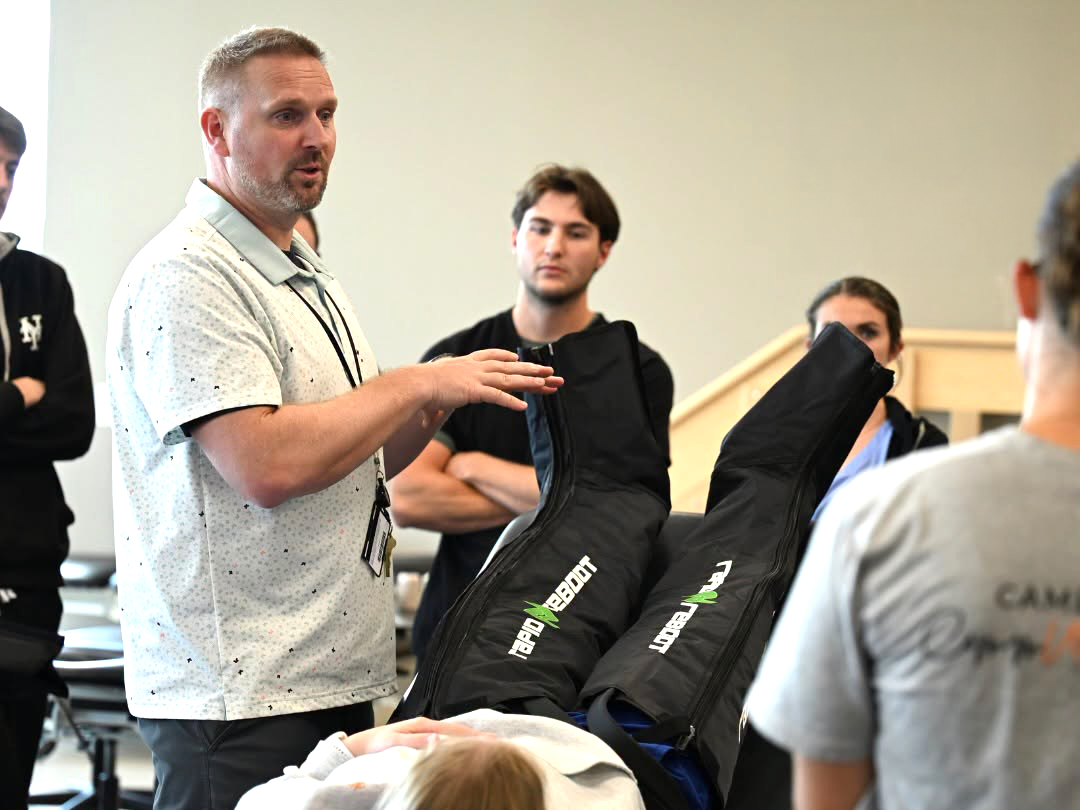
Dr. Randall Lazicki came to Campbell University last November as an assistant professor of physical therapy for the College of Pharmacy & Health Sciences. Prior, he worked with the football program at Duke University — and he offered his services to Campbell’s program upon his arrival in Buies Creek.
Once a week, Lazicki offers his services at the football facilities at Barker-Lane Stadium to help treat athletes and take part in their rehabilitation. He works a lot with post-operative students who are expected to be out for an extended period of time and need lengthier rehab.
A former college athlete himself (he played soccer as an undergrad), Lazicki says he got into physical therapy and athletic training when his mother informed him that he was going to college for more than just playing soccer — he needed to prepare for a career as well.
“I was the first person in my family to go to college, and my mom said I needed a degree I could actually use after graduation,” he said. “I chose athletic training … and I fell in love with it, especially the rehab side of it.”
He went on to earn a Doctor of Physical Therapy from Elon University and a Doctor of Education in Kinesiology from the University of North Carolina at Greensboro. He went on to serve in the military and was a contracted physical therapist and human performance advisor within the U.S. Army Special Operations Command and Air Force Special Operations Command. Today, he is an APTA Board-Certified Orthopaedic Clinical Specialist, Board-Certified Sports Clinical Specialist and Fellow of the American Academy of Orthopaedic Manual Physical Therapy. He’s also a Certified Athletic Trainer, holds several strength and conditioning credentials and continues to provide servant leadership to the APTA North Carolina.
He says the injuries he treats for football players are similar to the injuries suffered by athletes in all sports — shoulders, knees, lower backs and ankles are the main areas of concern on a weekly basis. He says successful athletic training programs are ones that promote interdisciplinary care — integrating knowledge, methods and communication across multiple distinct healthcare and performance specialties to build a single, cohesive plan for an athlete’s care, injury prevention or rehabilitation.
“Interdisciplinary care is a best practice, and when I get to work alongside athletic trainers, strength and conditioning staff and — in other programs — dieticians, psychologists and ministers, it just provides the best care for the student-athletes,” Lazicki says.
Lazicki worked at Campbell as an adjunct professor when the football program was still finding its legs in 2014 (just a few years after its return). He, like Beers, says being part of a historic season makes the job even more enjoyable.
“In athletics, when you’re winning, it’s a great mood,” he says. “It’s a great environment. I first came on at the tail end of last season, which didn’t end well, and you can see the mood change with the guys. This season, you can feel the change. The banter is more relaxed, but still professional. And the players feel better about what we’re doing for them.”