


RALEIGH – Do you remember being called to the principal’s office? Or when a student was placed on suspension and eventually ended up in prison?
Official data suggests nearly one in three people currently in state prisons were first arrested before their 16th birthday. Before even earning the right to vote or dreaming of going to college. The statistic gives weight to the powerful school-to-prison pipeline metaphor. It’s the reality of far too many young people whose lives are shaped by exclusion, punishment and missed opportunities, says Campbell Law School Clinical Professor Professor Jon Powell ‘98.
But what if breaking that cycle isn’t impossible? What if, instead, it is just a circle away?
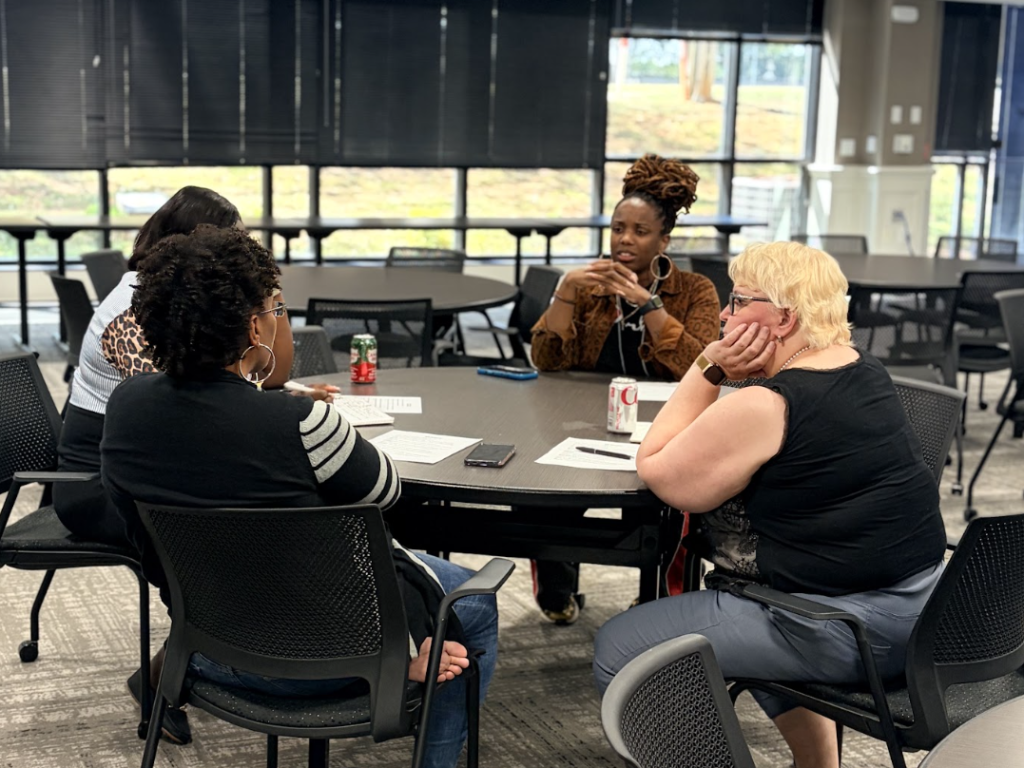
In September, Campbell Law School’s Restorative Justice Clinic (RJC) trained 14 educators in the Central Carolina Principal Preparation Program (CCP3) representing seven North Carolina schools in an intensive, two-day workshop on restorative justice practices.
Currently completing their Master of School Administration degrees, most of these leaders serve as assistant principal interns in their respective academic communities. Upon completing their degrees in May 2027, they will be qualified for assistant principle roles.
During the workshop, Powell, director of the RJC, and co-facilitator Eunice Torres-Browder, who also works with the RJC, focused on leveraging restorative principles to reimagine school culture.
-
-
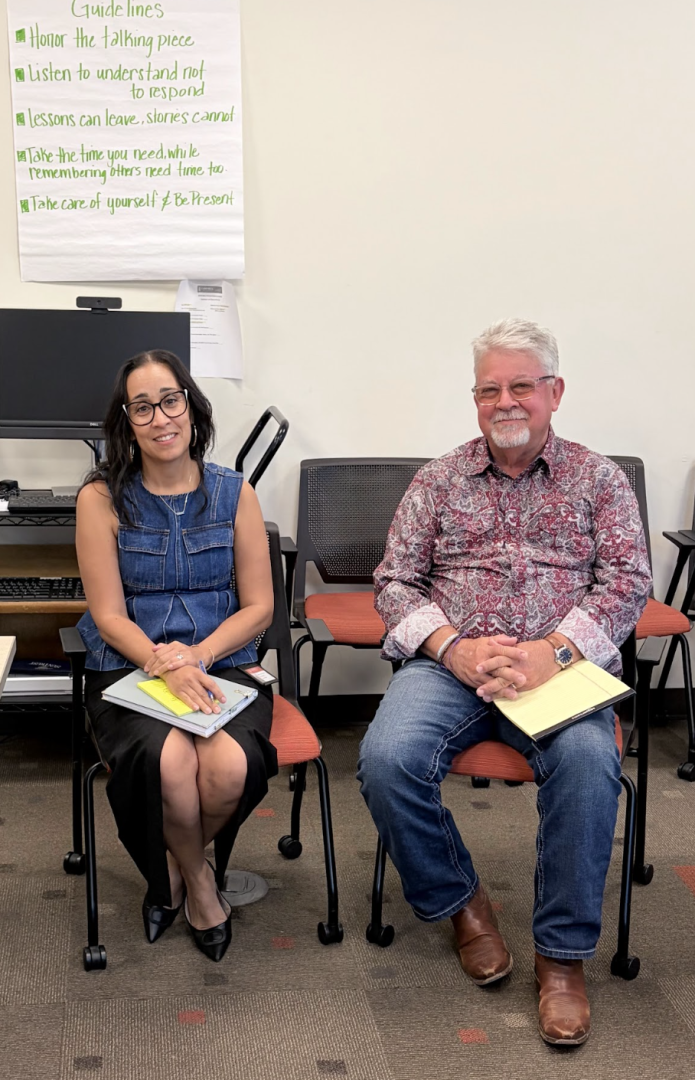
Eunice Torres-Browder and Professor Jon Powell ’98
The RJC strives to bring victims and offenders together using restorative justice practices in an effort to foster collaborative healing, rather than specifically seeking punishment. The RJC aims to discover how people and communities are hurt as a result of crime and seeks to find the best solution to repair the damage that has been done. The RJC receives referrals from juvenile intake counselors, juvenile court, the local school system and private individuals affected by crime or disruptive behavior.
-
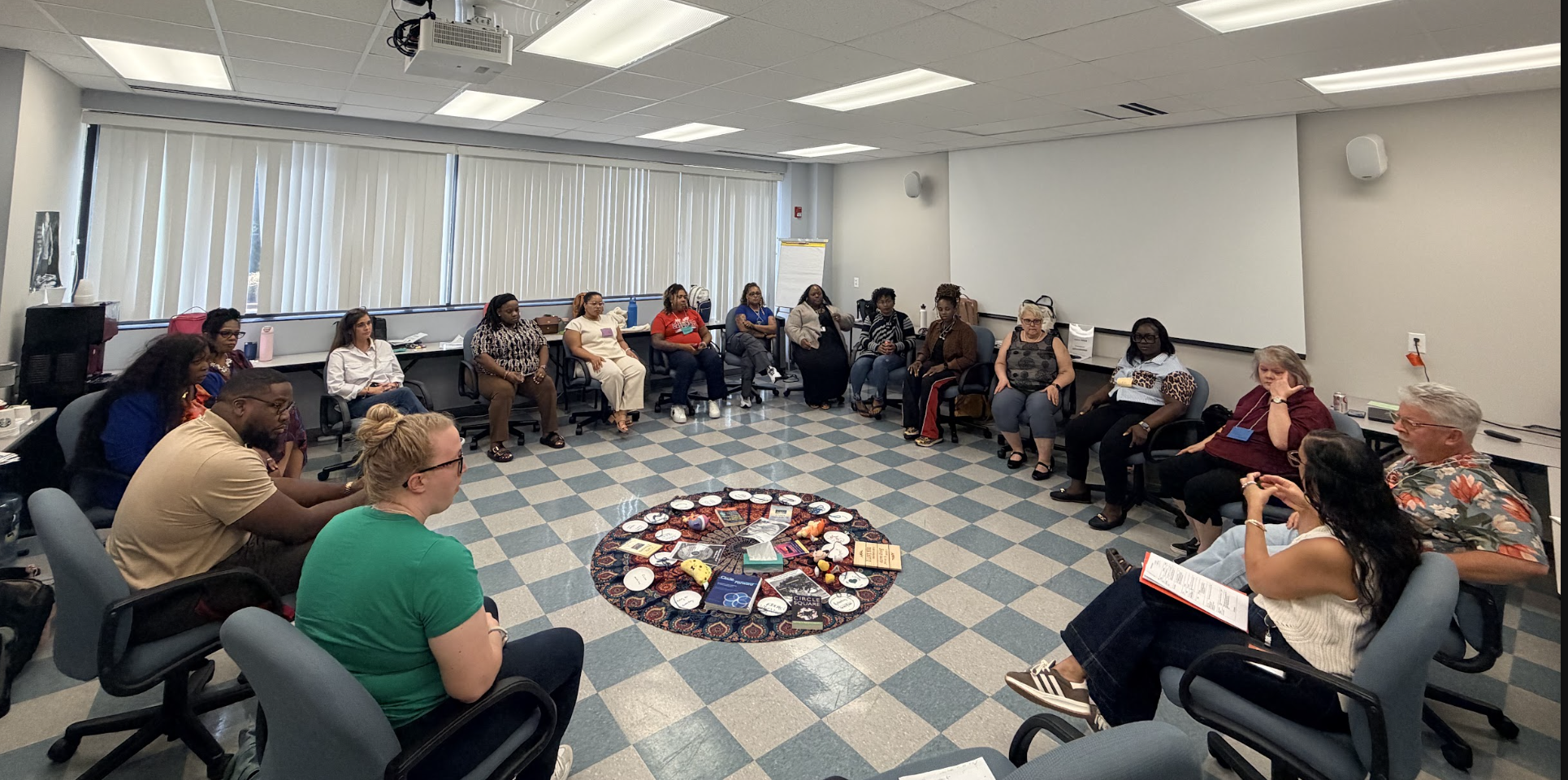
Powell conducted the educator training in a circle. Yes, a circle where everyone has an equal chance to speak. Where being in right relationship matters more than being “right.” Where rules are agreed upon before being enforced. Where tears are welcome, trauma is acknowledged and every person receives words of affirmation.
Creating these community-building spaces in school doesn’t reduce conflict; it transforms it, according to Powell. And when conflict does arise, restorative justice principles help repair harm, rebuild trust and restore dignity. Of course, addressing harm without causing more harm requires expertise.
“The circle is the best way I know to build relationships and create a healthy community which leads to better performance and happier individuals,” Powell says. “Thanks to Fay (Jones) for inviting us into this extraordinary group of leaders who now can make an informed choice to introduce their staff and students to this transformative work. We stand ready to continue to support them in their journey to create restorative schools and communities.”
And still these practices can’t be fully understood through description alone; one must experience them in person, Powell says. And that’s exactly what happened during the training.
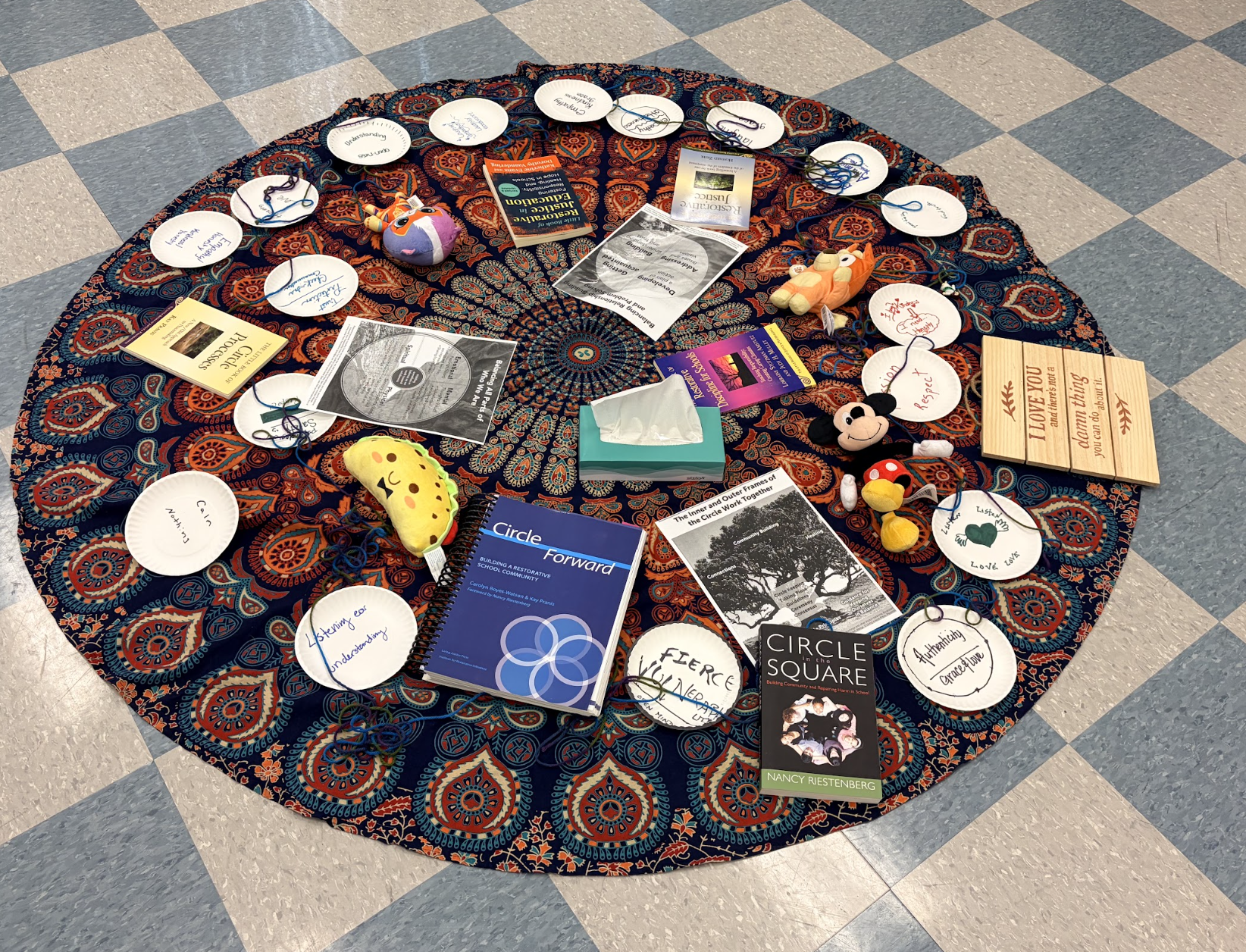
The workshop participants, seasoned educators with decades of experience, first deepened their connection with each other through guided prompts, team-building activities and simply calling each other by their first names. On the second day, each person shared a formative story from their life, an incident or a moment that shaped them, accompanied by an object representing that story. “Because real change begins with relationships,” Powell asserts. “The choice to train educators was deliberate, as a restorative culture requires buy-in from the leaders who set discipline policy if it is to survive.”
As part of the training, fellows also designed their own circles: some were created to make schools a more joyful experience for struggling children while another brought together staff to bridge the cultural divide.
“The circle keepers were exceptional,” said one participant from Wake County, who asked to remain anonymous. “They allowed conversations to flow freely while modeling the most important tenets of circle.”
Another reflected on “the emotional depth that came about from the circle experience,” while a third wrote about the workshop’s value. “It’s given me a good idea of what RJ practices should look like in a school and intrigued me to learn more about how it’s run at my school.”
Powell believes that sometimes the path forward can start with a simple circle. Campbell Law has been offering training on restorative justice practices through the RJC for 23 years. The RJC teaches community building through circles to reduce the possibility or severity of conflict, but responds differently when conflict arises at schools. In those cases, the Clinic facilitates dialogue between the child who caused harm and the child or individual who has been harmed in an effort to understand the needs of both parties and foster collaborative healing, rather than specifically seeking retribution. Such dialogue creates an environment for the person who caused harm to take responsibility for their actions and repair that harm, ultimately resulting in both parties coming together for a facilitated dialogue after rigorous preparation to address and satisfy their needs as a result of the incident,” Powell explained.
Repair can look different in different circumstances. But this exercise requires expertise and rigorous preparation with each individual involved before everyone comes together in a room. The RJC routinely receives referrals from juvenile intake counselors, juvenile court, the local school system and private individuals affected by crime or disruptive behavior.
In 2007, the Clinic was recognized by the North Carolina Governor’s Crime Commission as one of its leading programs for “outstanding dedication and achievement in service to the community in the area of Juvenile Justice.” In 2011, the Clinic hosted the third National Conference on Restorative Justice and attracted leading scholars, practitioners and participants in the field of restorative justice from around the world to Campbell Law. That same year, Powell was appointed to the juvenile planning committee of the North Carolina Governor’s Crime Commission, where he played a role in advising on all issues of juvenile crime across the state, as well as where federal dollars should be applied to address issues within the state.
The RJC, which is Campbell Law’s oldest pro-bono clinic, was initially established as the Juvenile Justice Project in 2003 as a clinical mediation initiative serving Harnett, Lee and Johnston counties. It was funded by the Governor’s Crime Commission and designed to handle juvenile criminal cases, most often assault and property crimes, through a restorative justice process that brings victims and offenders together for mediation. The program was later expanded in 2009, when Campbell Law received a two‑year $144,904 grant from the same commission to extend its services to Wake County following the law school’s move to downtown Raleigh. The Clinic was renamed the RJC in the fall of 2015.
ABOUT CAMPBELL LAW SCHOOL
Since its founding in 1976, Campbell Law School has developed lawyers who possess moral conviction, social compassion and professional competence and who view the law as a calling to serve others. Among its accolades, the school has been recognized by the American Bar Association (ABA) as having the nation’s top Professionalism Program and by the American Academy of Trial Lawyers for having the nation’s best Trial Advocacy Program. Campbell Law boasts more than 5,000 alumni, who make their home in nearly all 50 states and beyond. In 2026, Campbell Law is celebrating 50 years of graduating legal leaders and 17 years at a state-of-the-art facility in the heart of North Carolina’s Capital City.