

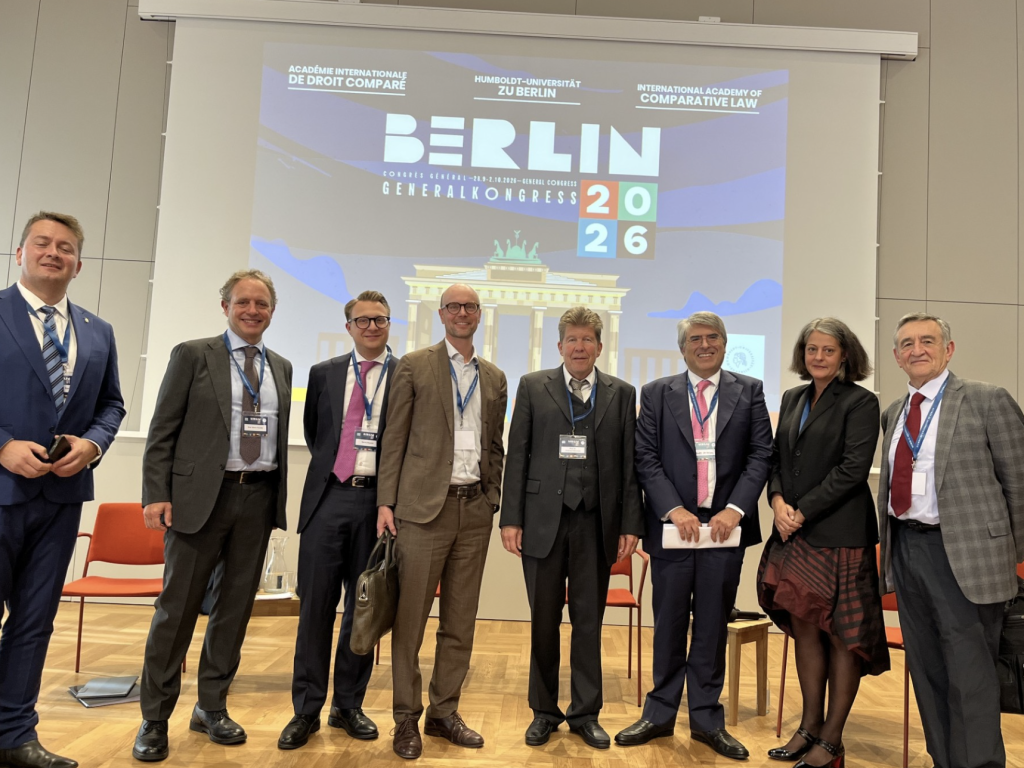

Joining her on the panel were:
- Professor Marco Torsello (Italy)
- Professor Andrea Schwartze (Austria)
- Professor Ben Koehler (Germany)
- Professor Alexander Metallinos (Greece)
- Professor Gyorgy Kovacs (Hungary)
- Professor Maciej Bujalski (Poland)
- Professor Luis Pinheiro (Portugal)
- Professor Alejandro Garro (Columbia Law School, United States)
- Professor Moritz Renner (Germany)
- Francisco Trebucq (Counsel, International Chamber of Commerce)
Additionally, Papadima’s article, “Validity of Asymmetrical Arbitration Clauses: Are We There Yet?,” was published in the Summer 2026 edition of the American Bar Association (ABA) magazine, The Brief.
The article, which was co-written with Alexandru Köber, examines asymmetrical (or hybrid) arbitration clauses, agreements where one party may choose between arbitration and litigation, while the other is confined to a single dispute resolution path. The article underscores that asymmetrical arbitration clauses can be enforceable if carefully drafted and supported by relevant case law, but their validity is highly jurisdiction-dependent.
Papadima teaches Sales and Leases, Business Organizations, Mergers and Acquisitions and International Business Transactions. She also coaches the law school’s teams competing in the Willem C. Vis international moot court competition in international commercial contracts and arbitration.
Prior to joining Campbell Law in 2019, she taught as an adjunct professor at the University Paris 1 Panthéon-Sorbonne (France) and the University of Bucharest (Romania) for seven years. She taught, among others, American, French, Romanian, European and International Business and Contract Law. After a decade as a corporate attorney at Latham & Watkins and Greenberg Traurig in New York, she opened her own private practice, focusing on Commercial Law. She advised American and European clients in the following areas: Corporate Law, Intellectual Property, Commercial Contracts, Commercial Litigation and Arbitration.
ABOUT CAMPBELL LAW SCHOOL
Since its founding in 1976, Campbell Law School has developed lawyers who possess moral conviction, social compassion, and professional competence, and who view the law as a calling to serve others. Among its accolades, the school has been recognized by the American Bar Association (ABA) as having the nation’s top Professionalism Program and by the American Academy of Trial Lawyers for having the nation’s best Trial Advocacy Program. Campbell Law boasts more than 5,000 alumni, who make their home in nearly all 50 states and beyond. In 2026, Campbell Law is celebrating 50 years of graduating legal leaders and 17 years of being located in a state-of-the-art facility in the heart of North Carolina’s Capital City.