



RALEIGH — Campbell Law School celebrated its 50th anniversary with more than 300 of its alumni, faculty, staff, current students and friends at a gala on Sept. 17 in Raleigh’s Union Station.
The event was attended by seven members of the inaugural graduating class of 1979 and such notable alumni as N.C. Secretary of State Elaine Marshall ‘81 and Charleston Southern University President Keith Faulkner ‘01, along with members of Campbell University’s cabinet and Board of Trustees and the law school’s Board of Visitors and Alumni Association Board of Directors.
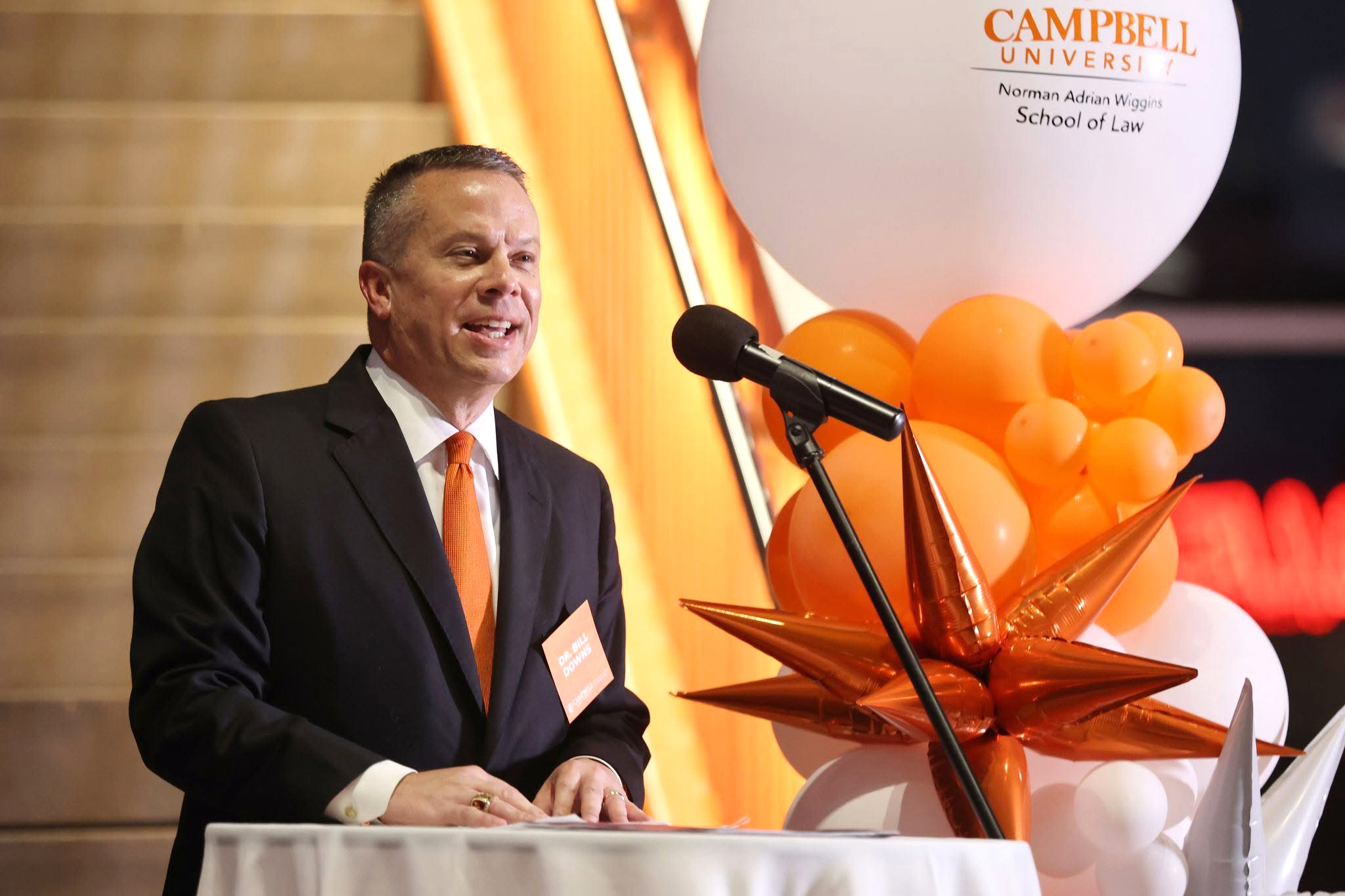
Campbell University President William Downs welcomed guests to the celebration saying the entire Campbell family was there in spirit. “We’re all proud of you and we’re all here to celebrate this group,” he said. “We’re all here to congratulate you for 50 years, which is truly, truly impressive.”

Downs added the true measure of the law school’s success extends beyond simple statistics or facilities, saying success is defined by the impact of the alumni serving as judges, ministers of justice and attorneys advocating for integrity. He also emphasized the law school’s commitment to public service and character as its true legacy, adding the goal is to ensure that when the centennial is celebrated 50 years from now, the next generation recognizes the same commitment to excellence and dedicated service.
Dean J. Rich Leonard, the law school’s fifth dean and longest serving law school dean in North Carolina, shared a brief history of the school with the crowd.
Campbell Law’s origin story began in the early 1970s, when several University of North Carolina‑system universities explored launching new law schools. The UNC General Administration rejected the idea, concluding in a 1974 study that North Carolina needed no new law schools and that existing institutions would soon produce more lawyers than the state could absorb. But then Campbell University President Dr. Norman Adrian Wiggins, for whom the law school is named, disagreed. He commissioned his own consultant, received a radically different assessment and formed a trustee committee that ultimately recommended moving forward. Despite resistance from leaders of other Baptist colleges, Wiggins was able to secure approval from the Southern Baptist Convention, and Campbell Law opened in August 1976 with 97 students and a $400,000 annual operating budget, Leonard explained.

Leonard added how founding Dean Leary Davis envisioned a small, personal, service‑oriented, academically demanding law school rooted in the Judeo‑Christian tradition. Campbell Law’s mission would be to train practice‑ready lawyers, emphasizing ethics, integrating theory with practical skills and preparing graduates to serve communities across North Carolina, especially in non‑urban areas.
Over the past five decades, Campbell Law has flourished, Leonard continued. It is now the second‑largest law school in North Carolina, with graduates excelling statewide and nationally. The school has earned national and international recognition for advocacy, professionalism and innovative training; achieved a historic 100% bar passage rate in 1994; and expanded experiential learning through its now seven pro bono clinics, which serve the local community and beyond.
“Dean Emerita Melissa Essary’s bold 2006 decision to move the school to Raleigh transformed its trajectory, and we have continued to embed Campbell Law in the state’s legal and governmental center ever since,” Leonard said.
Today, Campbell Law operates with a $15 million budget, sending more students to the North Carolina bar exam than any other school, competing nationally and globally in advocacy and offering international programs from Cambridge to Ghana, Leonard added. And generous alumni support continues to fuel growth, including major gifts from John McCabe ‘94 and Gary Shipman ‘80 along with Robert Zaytoun and many others.
“Campbell Law remains true to its founding mission: producing fearless, service‑driven advocates guided by integrity, compassion and a belief in the dignity of all people,” Leonard concluded.
Former Professor and Associate Dean Margaret Currin ‘79, who was the first student to enroll at Campbell Law School, gave the invocation. “We are especially thankful for the foresight and leadership of those founders who set the direction that has made Campbell Law School the special place it continues to be,” she said. “We are also thankful for the faculty and administrators who have taught and who have prepared … the more than 5,000 students who have entrusted their professional lives and education to Campbell Law over the years.”
Essary, who attended the gala, summed up the law school’s history and trajectory with one word, “dynamic.”

“It is such an honor to be here for the 50th anniversary of Campbell Law School,” she said. “The law school had its great roots in the soil of Buies Creek and it grew, it grew, it grew. So many legal giants have been produced by this school, incredible leaders, some of whom are no longer with us, and we honor all of them tonight and also the great work our current graduates are doing across the country and across the globe. The law school is dynamic because the law is dynamic. I think Campbell Law’s future is even better than its past.”
The gala was the culmination of a year-long celebration that began with the unveiling of a permanent timeline in the law school’s lobby in January. The timeline, which features all five of the law school’s decades, was funded in part by the Campbell Law Alumni Association.
Photos of the event can be found on the law school’s Facebook page at this link: https://www.facebook.com/campbelllawschool.
ABOUT CAMPBELL LAW SCHOOL
Since its founding in 1976, Campbell Law School has developed lawyers who possess moral conviction, social compassion, and professional competence, and who view the law as a calling to serve others. Among its accolades, the school has been recognized by the American Bar Association (ABA) as having the nation’s top Professionalism Program and by the American Academy of Trial Lawyers for having the nation’s best Trial Advocacy Program. Campbell Law boasts more than 5,000 alumni, who make their home in nearly all 50 states and beyond. In 2026, Campbell Law is celebrating 50 years of educating legal leaders and 17 years of being located in a state-of-the-art facility in the heart of North Carolina’s Capital City.