

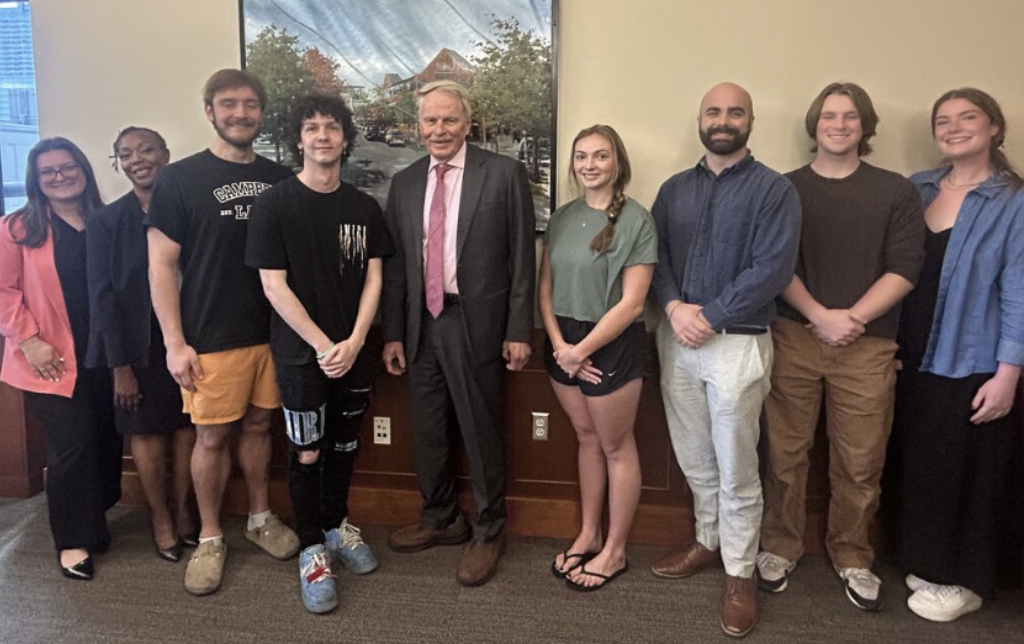

RALEIGH – Eight Campbell Law School students who participated in the inaugural Joseph E. Zaytoun International Judicial Clerkship Fellowship program in three African nations recently shared their experiences with members of the Craven-Everett Inn of Court.
During the Inn of Court’s first fall meeting, Jarrick Hawkins ’28 and Emma Rogers ’28, who were in Ghana; Angelena Antenuci ’27, Tracy Harris ’27 and Ryan Hogan ’28; who were in Namibia; and Lukas Ireland ’28, Eric Kinyon ’28 and Brittany Wilson ’28, who worked in Rwanda, provided their insights about what it was like to serve as clerks in the high courts of their respective countries.
The fellows credited Dean J. Rich Leonard for his innovation in setting up the student-oriented program. All of the students described their experiences as the opportunity of a lifetime. The students were also eager to recognize who made these unique experiences possible, giving special thanks for the generous contributions made by prominent North Carolina attorney Robert Zaytoun, owner of the Zaytoun Law Firm in Wilmington, in honor of his father Joseph.
“It really was a life-changing experience,” Harris explained. ”Namibia was very unique. It was trying to create its own precedent so the cases we worked on were actually doing that … So thank you Dean Leonard for selecting us and thank you Mr. Zaytoun. We are forever in your debt for this experience.”
For Kinyon, having the chance to gain legal experience in Rwanda felt like destiny.
“Going to Rwanda was a dream of mine for the past 10 years,” Kinyon told the gathering. “So when I heard about this program, it felt like destiny. And the legal experience I got there, meeting people in the court, it was a dream come true.”
The fellows also pointed to Leonard’s support for the program, recognizing his experience as a former federal bankruptcy judge, his personal experiences in Africa and his continued innovation of the program.
The fellows each described being taken under the wings of the chief justices and legal officers they were assigned to. Each was given specific assignments based on their prior experiences, resumes and areas of interest.
Harris said one of the justices the Namibia fellows had the privilege to work under had “literally written the civil procedure for the country,” while another chief justice she worked with was the first woman permanently appointed to the court.
The students said they were also relieved to find that everyone they had the pleasure of working with was friendly and played a big role in teaching them about the cultures they’d be stepping into.
As a point of cultural difference in the court structure itself, the library of the Supreme Court was accessible, which allowed the students to visit at their leisure and gain historical and cultural insights.
Rogers said they were met with similar enthusiasm and curiosity from the Ghanaian people. When she and Hawkins had the opportunity to make a presentation at the U.S. Embassy, Rogers described the audience as “engaged and interesting people who wanted us to explain the entire American government.”
Conversely, the fellows found witnessing the differences between the court proceedings abroad and those in America to be enriching. They said the African courts felt more hectic than typical American courts.
Hogan remarked the African courts sometimes resembled the stereotypical tense courtroom scenes found in movies with fervent arguing and people talking over each other.
“It normally took about three different iterations of gavel banging for the arguing to finally die down,” Hogan said. “It was quite entertaining. That was probably the most exciting day on the job that we had.”
The Namibia fellows had the opportunity to meet a U.S. Ambassador and several other diplomats, which led to being featured on the local news.
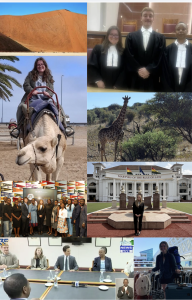
All of the students said they were able to step outside of the courtroom to experience the culture they were surrounded by through a variety of activities including going on desert hikes and camel rides, sampling local cuisine, visiting art galleries and even going on a safari to spot rhinos.
When asked how she felt on the last days of her Namibia experience, Harris responded, “I really looked into citizenship in the country … It felt like home.”
Ireland tied together the fellowship’s shared purpose, speaking about the strength of Rwanda as a nation having to rebuild in the face of profound horror as well as his experience having the opportunity to work within the legal system developed in its aftermath.
“In 1994, Rwanda had a horrific genocide. About a million people were killed in about three months,” Ireland explained. “But the way Rwanda rebounded, they really kinda went head first into a culture of forgiveness and acceptance and it really showed throughout their legal system.”
Ireland continued, “Refugees were coming back that have been in exile for decades. It was a humongous change and from that, Rwanda has really been innovating underneath their President Paul Kagame, who was one leader of the rebel group that helped to save people from the genocide and he’s been in power for many, many years. Underneath him, Rwanda is specifically legally innovating in a lot of different ways. And that was part of what we were doing inside of that court.”
Hogan added, “It was an incredible opportunity. And to learn from such a unique environment this early in my career, I will be forever grateful to Campbell, Dean Leonard and Mr. Zaytoun.”
ABOUT CAMPBELL LAW SCHOOL
Since its founding in 1976, Campbell Law School has developed lawyers who possess moral conviction, social compassion, and professional competence, and who view the law as a calling to serve others. Among its accolades, the school has been recognized by the American Bar Association (ABA) as having the nation’s top Professionalism Program and by the American Academy of Trial Lawyers for having the nation’s best Trial Advocacy Program. Campbell Law boasts more than 5,000 alumni, who make their home in nearly all 50 states and beyond. In 2026, Campbell Law is celebrating 50 years of graduating legal leaders and 17 years of being located in a state-of-the-art facility in the heart of North Carolina’s Capital City.