

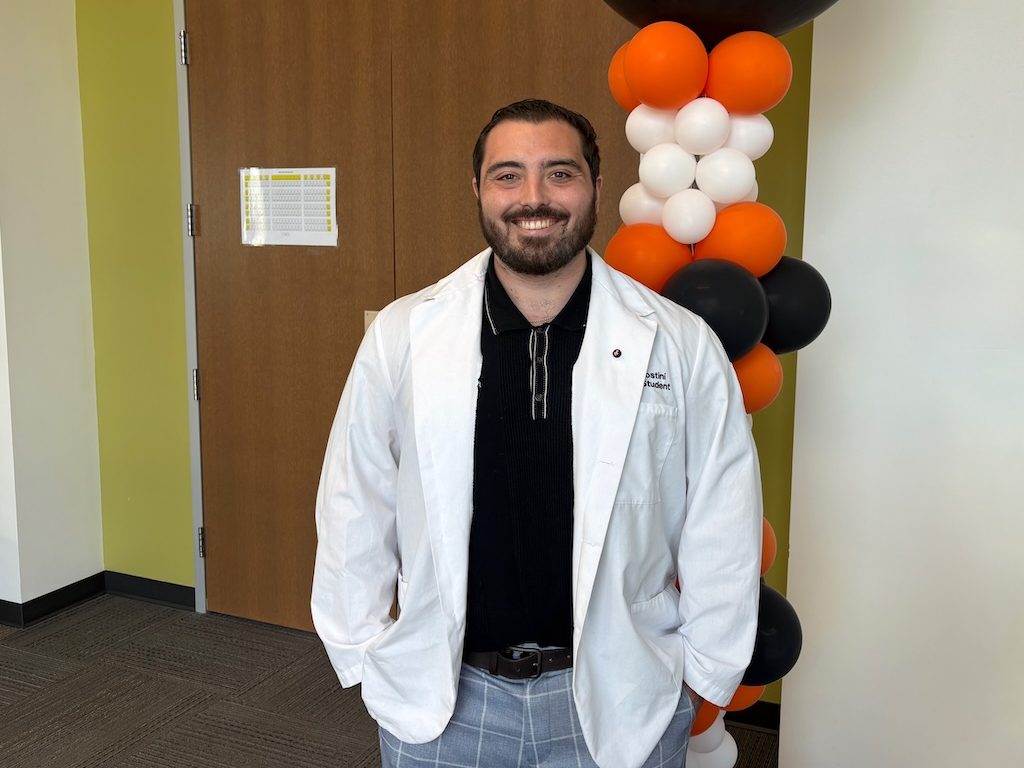

Student Dr. Kyle Agostini has earned myriad academic honors while studying osteopathic medicine at Campbell University.
A native of Long Island, New York, Agostini chose Campbell, in large part, based on a passion for osteopathic and holistic medicine. A belief the human body possesses an innate capacity for healing and regeneration. He has traveled with his peers on medical school mission trips to places such as the Dominican Republic and Guatemala.
It’s that inherent devotion toward helping people, toward healing them and learning about the world’s disparate cultures — just as his peers at the med school — that led Agostini to the Order of Malta and, this spring, to Rome. 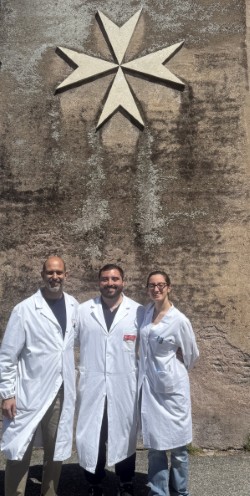
Agostini, who wants to specialize in Physical Medicine and Rehabilitation, or PM&R, spent two weeks on a medical observership in a sub-acute rehab hospital in the Italian capital. Raised in a Catholic family, he became familiar with the Sovereign Order of Malta, one of the oldest institutions of Western and Christian civilization, its website says.
The Order of Malta is active in 130 countries caring for people in need through its medical, social and humanitarian works. Agostini traveled to Italy with the help of a scholarship from St. Bernadette Catholic Parish.
“A lay religious order of the Catholic Church since 1113 and a subject of international law, the Sovereign Order of Malta has diplomatic relations with over 100 states and the European Union, and permanent observer status at the United Nations,” the site says.
“I reached out to (Order of Malta) leadership from my area … and said that this is what I wanted to do, and this is what I was looking for. They went and reached out to a bunch of places, and it just worked out that I could go to Rome,” says Agostini, who later this summer enters his fourth year in the Jerry M. Wallace School of Osteopathic Medicine (CUSOM).
Agostini learned about how the Italian system of healthcare differed from that of the U.S. About how doctors and other healthcare professionals related and cared for patients in Italian rehab hospitals, which he found communal, even around the intense care provided to patients who suffered severe injuries.
“I’ve seen a mix of outpatient procedures and inpatient anoxic brain injury recovery,” he said. “I’ve had the opportunity to inhabit their system, which has given me a new appreciation for the strengths and limitations of our own system.”
The physicians, he said, didn’t always rely on electronic records, rather relying on the patient to present pertinent records, allowing the patient to steer care based on their current condition and needs.
The patients come to the physician, who’s already waiting for them, Agostini says. Visits typically last about 20 minutes.
“The patients walk in and they get a number, the doctor calls the number, and then that starts a timer … and the visit starts.”
Agostini spent a lot of time with patients, despite the language barriers and what he calls his “seventh-grade” Italian.
“They actually had at least one person in each department that spoke very good English,” he says. “Walking around the traumatic brain injury unit, I had a neurologist with me who was walking me through all the patients, kind of translating a little back and forth.
“Whenever patients said things to me in the clinic, I used Google Translate so that I could listen to what the patients were telling the doctor, and then when I had questions I could talk in English to the doctor, and we could kind of go back and forth that way. So, I also got to help out with some procedures.”
He assisted in botulinum toxin injections to treat spasticity, and another in which a woman, who was using a wheelchair, couldn’t separate her legs. While the physician guided the needle with ultrasound, Agostini operated the nerve stimulator, confirming the needle was positioned on the nerve rather than surrounding muscle before the phenol was injected.
“I pushed the phenol in to kill the nerve, and then, within like a minute, she was able to open her legs.”
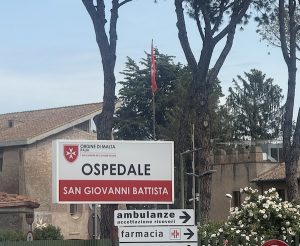
Agostini’s fiance accompanied him to Italy. Together, they enjoyed the city, the culture, the food. They attended mass in St. Peter’s Basilica, toured the ruins, dined on pizza and salumi.
“Before this trip, my PM&R exposure was entirely outpatient, and I wasn’t sure how much the role of the physician actually changes in the inpatient rehab setting. What I saw was that it doesn’t, not fundamentally,” Agostini says.
“Whether someone is recovering from a brain injury or managing chronic spasticity, PM&R is about meeting people where they are and being a consistent, warm presence that orients them toward their own healing, whatever that looks like for them. That’s the same instinct osteopathic medicine is built on, and it’s the part of this work I feel most prepared for.”
Said CUSOM Family Medicine Chair Dr. Robert Agnello, “Student Dr. Agostini exemplifies the ideal of osteopathic philosophy, always considering the mind, body and spirit connection of all patients that he works with. It is an honor to be part of his training.”