
_____
THE TOP 5 IN ’25
The biggest stories from a historic 2025 at Campbell
It was a historic year for Campbell University, which experienced something that had only happened five other times in the school’s 139-year history — the transition to a new president.
Dr. William M. Downs became Campbell’s sixth president on July 1, succeeding Dr. J. Bradley Creed. The event was the University’s top news story in a year full of positive change and notable accomplishments.
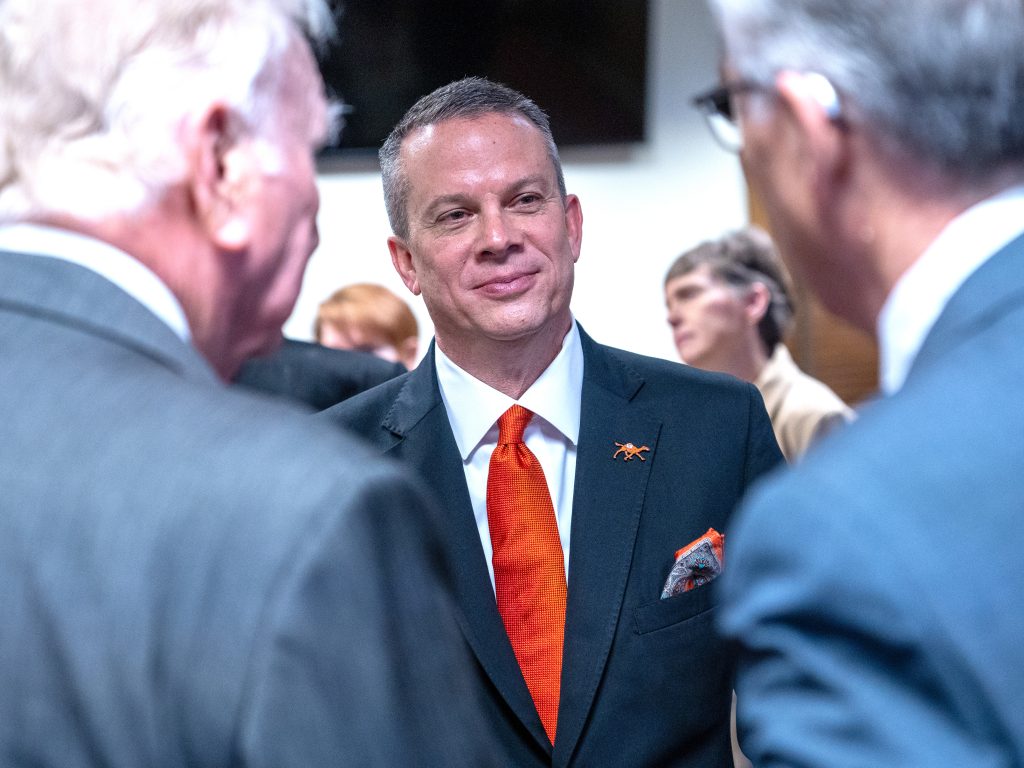
1 | A NEW PRESIDENT
His message was clear the day he first stepped on campus on a cold, gray mid-February day just minutes after officially being announced as the sixth president in Campbell University’s storied history.
Dr. William M. Downs was ready to get to work.
“I have studied as much as I can about Campbell University,” Downs told a chapel full of faculty, staff and students that day. “I have absorbed the data; I have watched every YouTube video possible. I’m an up-tempo guy, and the moment I arrive on July 1, we’re going to get busy. I’m excited about that.”
True to his word, the first six-plus months of Downs’ tenure in Buies Creek — which officially began on July 1 — have been productive. A six-city speaking tour from the Queen City to the coast. Three town hall meetings dedicated to laying the groundwork of a five-year strategic plan. Meetings and guided tours with every dean and nearly every program on campus. Immediate improvements to the student experience on campus. A new staff appreciation awards program. New admissions initiatives for both undergraduate and graduate programs. A record-breaking Giving Day.
And those are just the public-facing events.
Downs has said his goal from Day 1 has been to bring “eager ears, fresh eyes and a jolt of energy, optimism and positivity” to his role as president, as well as a willingness to search and ask for the resources that are needed. In his first Campbell Forward speaking tour stop in Charlotte in September, he laid out three priorities for the coming months — strengthen and defend what works well at Campbell, fix what doesn’t work well and “have the audacity to dream big about Campbell’s future and the determination to deliver on those dreams.”
His first big goal is a new and ambitious strategic plan, which Downs announced on Jan. 5 was complete and nearly read for a public release. Campbell University 2026-2031: A Strategic Plan for Renewal, Growth and Recognition will, according to Downs, “clearly and succinctly map out a set of institutional priorities that will guide us into a bright future.” He said it will reaffirm core commitments, sharpen institutional identity, pinpoint a set of unexploited opportunities and help direct resources in ways that will maximize impact.
“The best plans are those that focus on a limited number of ambitious but achievable objectives that will facilitate forward progress,” he said. “The best plans are bold, distinctive and authentic.”
Downs succeeded Campbell’s fifth president, Dr. J. Bradley Creed, whose 10-year tenure at Campbell was marked by the addition of a new student union, a “character education” initiative that culminated with the launch of Campbell’s “Hallmarks” program and navigating the school through the COVID pandemic.
Read More:
- Dr. William M. Downs named Campbell’s sixth president (Feb. 11)
- ‘New chapter’ begins with two-day introduction (Feb. 12)
- Campbell University welcomes Dr. William M. Downs (July 1)
- New laundry units among several residence hall improvements (July 15)
- HVAC, boiler systems among significant campus improvements (Aug. 7)
- Downs touts ‘mission, people, location’ in fall welcome message (Aug. 15)
- Law School’s Jackson first recipient of Cherished Camel award (Aug. 29)
- President addresses dreams, challenges at first tour event (Sept. 19)
- ‘Town and gown’ — Downs touts Campbell’s role in the community (Oct. 30)
- After 10 years, J. Bradley Creed officially retires as president (June 30)

2 | ALL EYES ON ENROLLMENT
One of President Downs’ first calls to action as president was enacting a “new and aggressive recruitment strategy across North Carolina, around the Southeast and throughout the nation.” That initiative started at home, and on Dec. 8, Campbell announced that beginning in the fall, new full-time students who reside in Harnett County would receive free tuition for all four years of their college career.
“With this new initiative, we signal to the neighbors in our own backyard that Campbell can and should be their home, their destination of first choice when deciding on where to get a world-class college education,” Downs said. “We know that access and affordability are key concerns for college-seekers, and Campbell will be rolling out a variety of new incentives for multiple constituencies, all while maintaining the exceptionally high value associated with the quality of a Campbell education.”
The announcement was one of several involving enrollment at Campbell during Downs’ first semester. Before he officially took office, he named Dean Clark — whom he worked with while at Gardner-Webb University — as vice president for enrollment management.
In September, Clark and Downs announced new initiatives for freshmen and transfer students who enroll early and added significant tweaks to the J.A. Campbell Scholarship program. The Early Campbell Commitment program was created to offer incentives to incoming students who are admitted by Nov. 15 and deposited by Jan. 15. Benefits for those students will include early registration and early choice on on-campus housing. The full-ride J.A. Campbell Scholarship program was revamped to allow for more applicants and a guaranteed $2,000 for those who simply show up on campus for the annual scholarship competition.
In November, Campbell announced a new Guaranteed Pathway program for undergraduates interested in Campbell’s PharmD graduate program, and the University signed a transfer articulation agreement with Cape Fear Community College to provide a “direct and seamless” pathway for CFCC students to continue their education at Campbell.
Read more:
- Dean Clark named vice president for enrollment management (June 11)
- Campbell announces Legacy Scholarship recipients (July 10)
- Admissions launches early enrollment, scholarship initiatives (Sept. 12)
- Campbell, Cape Fear CC sign transfer articulation agreement (Nov. 10)
- Campbell announces Guaranteed Pathway to PharmD program (Nov. 11)
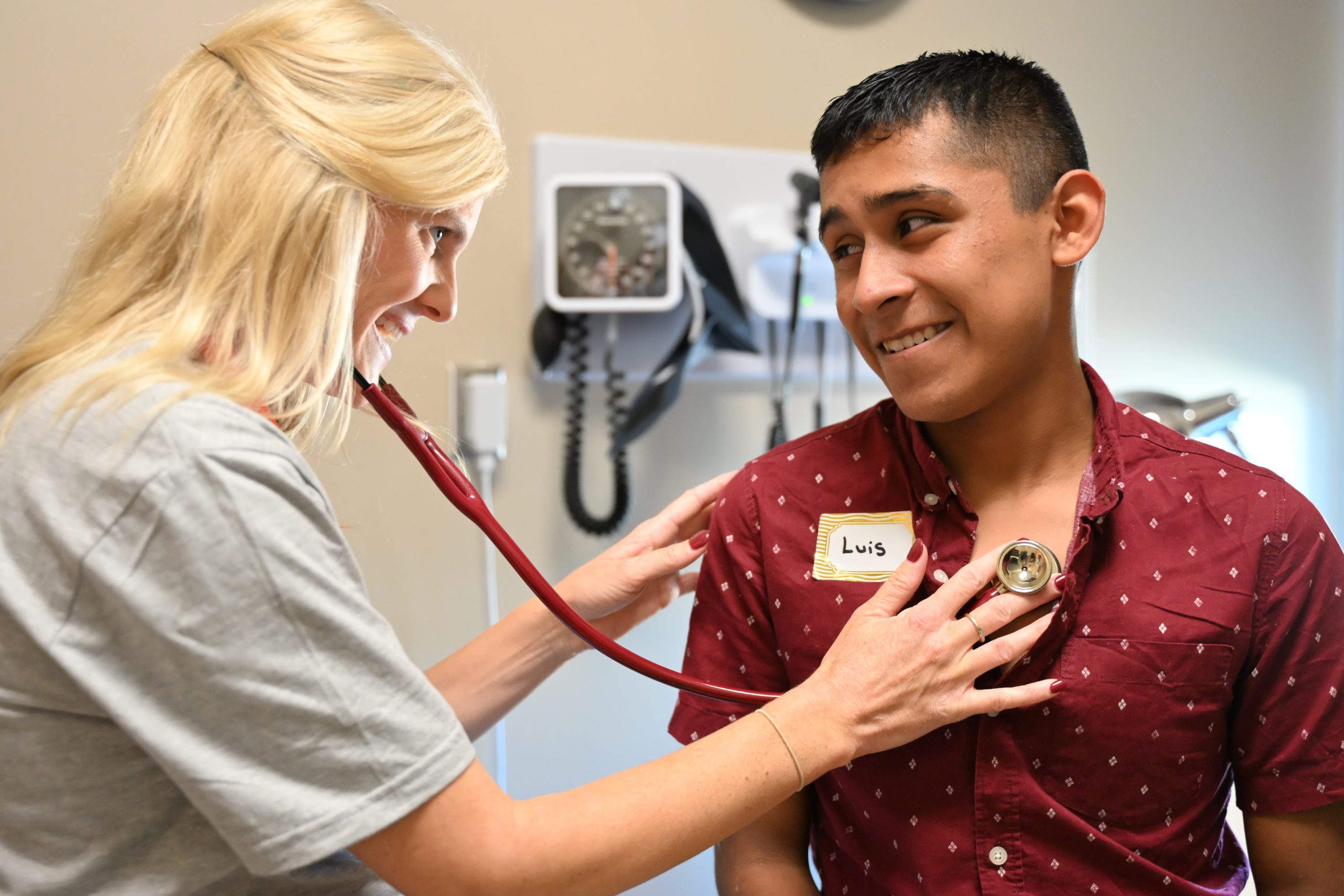
3 | GROWING HEALTH CARE FOOTPRINT
The Fall 2025 edition of Campbell Magazine features a cover story highlighting Campbell’s nursing program — now entering its 10th year, the undergraduate program has grown to become one of the University’s top undergraduate majors. The new class last fall was the program’s largest in its history.
The magazine featured students and staff who spoke of their passion for nursing, many of them saying it was their calling. On the cover, junior Emily Pierce — also a cross country athlete at Campbell — shared how her experience as a 7-year-old who underwent brain surgery shaped her desire to become a nurse or nurse practitioner, possibly in pediatrics.
“My goal is to be able to connect with my patients and make them feel better and make their day better — to make someone smile during their most vulnerable moments,” she said. “With kids, even the smallest thing you can do can mean the world to them. Having gone through it all myself, I can tell them that their setbacks are going to be the reason they come out stronger.”
Students in all of Campbell University’s health science programs — from medicine to pharmacy, physician assistant to physical therapy, nursing to public health and more — share similar “calling” stories that led to their goal to one day “serve the underserved.”
In April, Campbell’s Jerry M. Wallace School of Osteopathic Medicine was ranked among the best in the nation for “Medical Schools With the Most Graduates Practicing in Rural Areas,” according to U.S. News & World Report. Serving rural communities in North Carolina with the goal of keeping physicians in those communities is a primary goal of Campbell, which boasts the only osteopathic medical school in North Carolina.
“This recognition speaks directly to who we are and why we exist,” said Dr. Brian Kessler, former medical school dean. “Campbell focuses on preparing physicians who are committed to serving where they are most needed.”
In September, all of Campbell’s health science programs came together for a day of service throughout the Triangle as part of the second annual Camels Care CommUNITY Days. The program was launched in 2024 by the College of Pharmacy & Health Sciences as a way to bring students, faculty and staff together to serve the communities that support Campbell University.
Organizers say the two-day event is about more than volunteering — it’s about living out Campbell’s mission of service, leadership and community engagement. Campbell students and staff were seen at nearly 20 separate events and projects, including food banks and donation sites in Raleigh, Dunn, Durham and Fayetteville, Make-A-Wish Eastern N.C., Special Olympics, as well as the Miracle League of the Triangle in Cary, among many others.
“The interprofessional nature of this initiative, with students, faculty and staff from a range of health professions working side by side demonstrated the strength of teamwork and the value of learning from one another in service to others,” CPHS Dean Dr. Jeff Mercer said.
In October, the University joined community leaders in a ribbon-cutting ceremony for a new community care clinic in Dunn, which on Tuesday nights, offers free visits, lab work, imaging and medications to people who would not otherwise have access to health care. A month later, the med school cut a ribbon on a new 6,000-square-foot station house, home to the University’s four mobile health and education clinics, which deliver crucial healthcare services to underserved individuals throughout the region.
Read more:
- Medical school introduces Doctor of Behavioral Health degree (April 2)
- Campbell med school among best for graduating rural physicians (April 8)
- School of Nursing welcome record-breaking class (Aug. 18)
- Med school to offer new class for parents of newborns (Sept. 3)
- Second annual Camels Care Community Days serves the Triangle (Sept. 18)
- University, community leaders cut ribbon on Dunn Community Care Clinic (Oct. 15)
- Med students bring mission of hope, love, care to Guatemala (Oct. 29)
- Dr. Pennings speaks to global audience during Rome Lipedema Congress (Nov. 17)
- Medical school celebrates opening of new mobile unit station house (Nov. 25)
- Public Health alumnus honored with Algernon Sydney Sullivan award (Dec. 12)
- Nursing at Campbell: Putting the ‘care’ in healthcare (December)
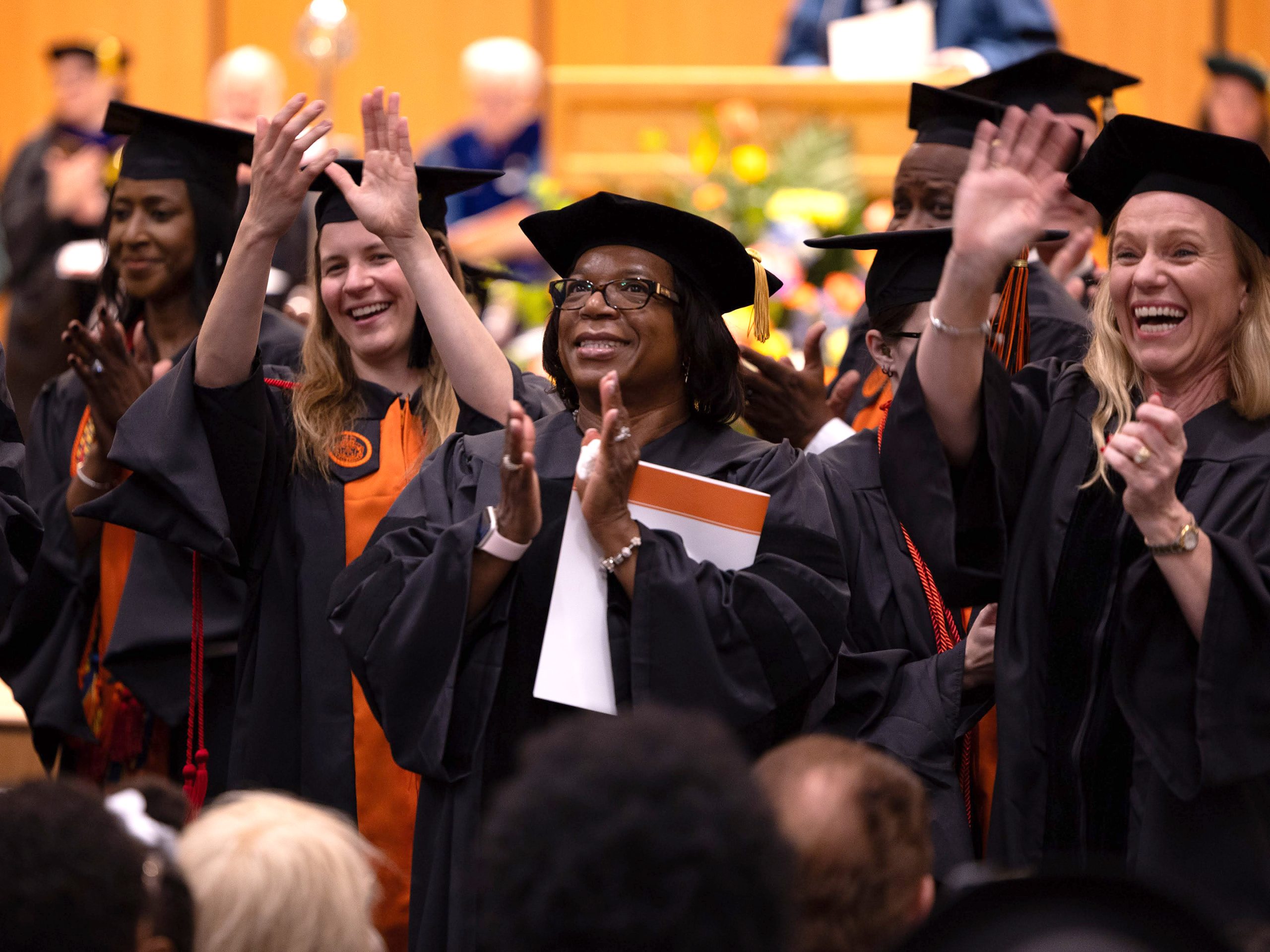
4 | ADVANCING THEOLOGICAL EDUCATION
Campbell University, from Day 1, has been a school built by faith — one that embraces the belief that there are no conflicts between the life of faith and the life of inquiry. The past year was a big one for theological education at Campbell.
On Dec. 3, Campbell announced it will receive a $10 million grant from Lilly Endowment Inc. in support of the Divinity School’s efforts to prepare and support pastoral leaders now and in the future, renewing the communal practices and relationships that help Christians discern and respond to God’s call.
The Divinity School will use the grant in collaboration with Campbell’s Office of Spiritual Life and five partner organizations to establish a new academic center, the Center for Calling and Ministry, to develop programs that strengthen cultures of calling within churches, schools and denominational organizations.
The Center will coordinate shared learning, messaging and resources across partners, providing the structural backbone for an enduring network that identifies, prepares and supports pastoral leaders for the church’s current and future needs.
Three months prior to the big announcement, the Divinity School formally installed just its third dean since its founding in the mid-90s. Dr. Barry Jones, a native North Carolinian and Campbell graduate, was named dean after spending the previous 25 years teaching at Campbell.
“I want the Divinity School to play a positive role on the campus,” he said. “I want the Divinity School to contribute to the spiritual community on campus. I’d like for us to be encouragers of other people in living out their faith and living out their calling no matter what their job or subject area is. And so I think that’s very important for the school.”
Earlier in the year, Campbell named Dr. Rachel Nelson as its director of Hallmarks and Character Education, overseeing the University’s efforts to implement the hallmarks of character, initiative and calling into the undergraduate learning experience in ways that align with the university’s mission, context and culture.
In 2024, Campbell became one of 29 schools to receive an Institutional Impact Grant from Wake Forest University’s Educating Character Initiative, in an effort to enable institutional leaders, faculty and staff to infuse character education into their curricula.
The year ended on a sad note for Divinity School alumni and staff as Dr. Michael Cogdill, the school’s founder, passed away at the age of 76. In 1995, the University tapped Cogdill to start a new graduate theological school in response to dramatic changes in the leadership and direction of the Southern Baptist seminaries. He often talked about the challenge and the excitement of beginning Campbell Divinity School “with a blank sheet of paper.”
“The legacy of Dr. Michael Cogdill is hard to describe adequately in words. He was a professor and dean with a pastor’s heart,” said Jones. “He believed that academic excellence and service to the church went hand-in-glove. He understood and taught that Christian ministry had to satisfy the mind and speak to the heart.
“Campbell University Divinity School was built on the personal trust that many, many people across North Carolina had in Mike Cogdill’s character and leadership.”
Read more:
- Campbell Law School ranks among ‘Most Devout’ for fourth time (Feb. 3)
- Campbell names new director of hallmarks, character education (March 27)
- Divinity professor elected to prestigious American Theological Society (May 23)
- Q&A: New Divinity School Dean Dr. Barry Jones (Sept. 24)
- Divinity School’s Fun Day focuses on family, togetherness (Sept. 25)
- Campbell to receive $10 million grant to support theological education (Dec. 3)
- Founding dean of Campbell Divinity School dies at 76 (Dec. 12)
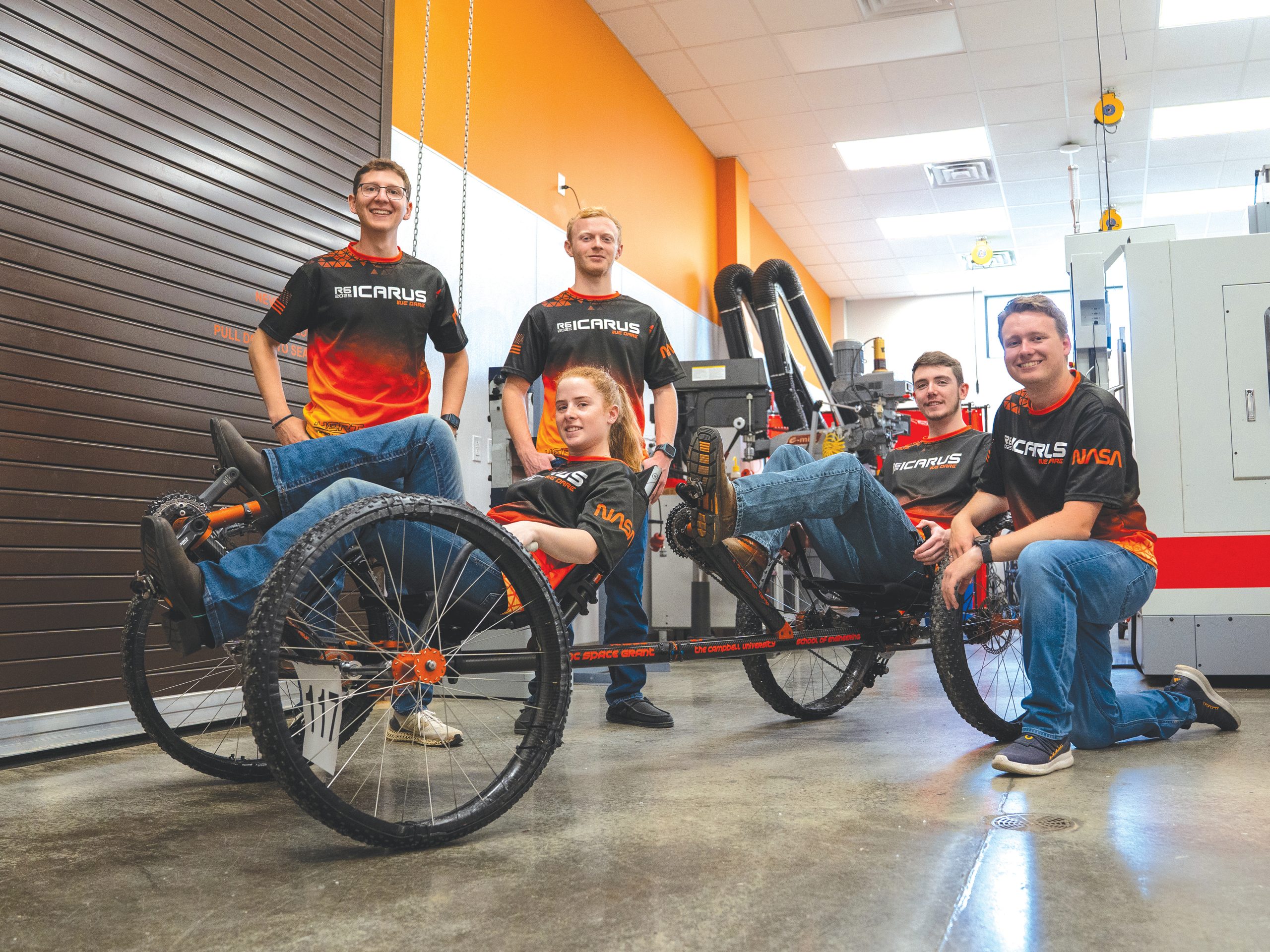
5 | ENGINEERING BUILDS A WINNER
It’s hard to pick a Top 5 when so much “good” happens at a university over the course of a year. Campbell Athletics enjoyed a solid season and its first-ever Coastal Athletic Association team championship when volleyball won the conference tournament in November. Campbell’s Lundy-Fetterman School of Business launched a new risk management program, and its one-of-a-kind trust program was featured in the spring edition of Campbell Magazine. And Campbell’s Norman A. Wiggins School of Law welcomed its 50th incoming class in the fall as it approaches the 50th anniversary of graduating legal leaders in 2026.
But we can’t overlook the accomplishments of Campbell’s young School of Engineering, which did the impossible last spring by winning first place in NASA’s Human Exploration Rover Challenge in Huntsville, Alabama.
Competing for just the seventh time since 2019, Campbell took top honors at the HERC competition, which draws more than 500 students from 35 colleges and universities and 40 high schools from 20 states, Puerto Rico and 16 other countries.
Teams are given instructions each December and are tasked with building a machine that can navigate a half-mile obstacle course — built to simulate the surface of Mars — while conducting mission-specific task challenges and completing multiple safety and design reviews with NASA engineers. NASA expanded the competition this year to include a remote-control division and invited middle school students to participate.
The rover challenge is one of NASA’s eight Artemis Student Challenges reflecting the goals of the Artemis campaign, which will land Americans on the Moon while establishing a long-term presence for science and exploration, preparing for future human missions to Mars.
NASA wasn’t the program’s only accomplishment in 2025. In October, a group of engineering students (and one political science student) were tasked with drawing up a plan to power the City of Raleigh over the next 30 years while cutting down costs for residents and improving the environmental impact.
The Future City Fellowship, in its pilot year, is an extension of the Future City Competition from Discover Engineering, a nonprofit committed to sparking students’ interest in engineering, strengthening their STEM skills, and deepening their knowledge. Campbell’s team of Emma Golden, Zane House, Ethan Kessler, Nicholas Ramsey and Angela Steen were part of a pilot project for university students to take part in the competition. The team developed 10-, 20- and 30-year plans to electrify Raleigh using solar panels, electric vehicles and small modular nuclear reactors.
Campbell was the only pilot collegiate program entered in this year’s fellowship program. They’ll be joined by other universities in 2026.
To start the year, the School of Engineering paid tribute to its home, Carrie Rich Memorial Hall, which celebrated its 100th anniversary. Founding Dean Dr. Jenna Carpenter, to kick off the year-long celebration of her school’s first decade, led a 100th birthday party for Carrie Rich on Jan. 29 that included balloons, cake and stories told by representatives of all the programs that got their start in the now century-old building.
Read more: