


Rural healthcare faces many challenges.
These include issues relative to transportation, holes and gaps in coverage and the inherent difficulties in recruiting physicians, which, as a consequence, can limit accessibility to needed specialists and providers.
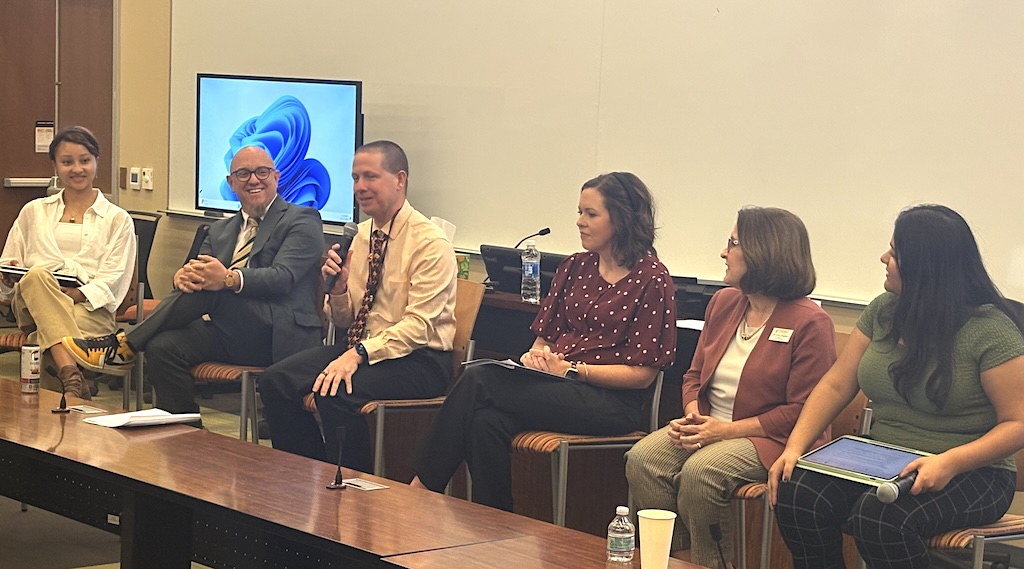
Physicians and healthcare professionals talked about those challenges as part of panel discussion, “Equity in Care: Advancing Rural Medicine in Harnett County,” held Oct. 16 at the Jerry M. Wallace School of Osteopathic Medicine (CUSOM).
Beyond the challenges, panelists discussed possible solutions and ongoing progress in regard to treating and caring for patients in rural communities.
Second- and third-year students in the AERIMUS program at Campbell’s medical school planned and implemented the panel discussion, also held in the Harnett County community.
“Our focus was identifying particular barriers and challenges to rural healthcare with a goal of identifying where we, as future physicians, can be involved now as students and in the future as professionals,” says student Dr. Brendan Di Cerbo, class of 2029 president.
Second-year students Drs. Ananda Chaplin and Nehal Chakraborty were moderators, and student Dr. Lacey-Ann Reynolds, also in her second year of medical school, played a key role in developing the panel, Di Cerbo said.
Dr. Brianne Holmes created AERIMUS. She is director and assistant professor of Professional Development at CUSOM. The program, says Holmes, helps medical students grow into thoughtful leaders, advocates and allies for the communities they will one day serve. AERIMUS is an acronym for “Advocating for Health Equity, Research and Inclusion for Medically Underserved and Special Populations.”
The AERIMUS program ultimately gives students a framework to connect what they learn in the classroom to the realities of clinical care and community needs, shaping them into empathetic, justice‑minded physicians.
The panel discussion included Dr. David Tillman, chair of the Department of Public Health in the College of Pharmacy & Health Sciences; Ainsley Johnson, a registered nurse and director of the Harnett County Department of Health; Dr. Robert Agnello, chair of Family Medicine at Campbell; and Dr. Lori Langdon, chair of Pediatrics and director of the campus Health Center.
“I am a lifelong North Carolinian that spent almost all of those years in rural places,” Tillman said. “This is not my object of study; these are my people. This is where I am from.”
Tillman told a story that centered around the birth of his daughter. For the mother, the only obstetrician assigned to the hospital recommended bedrest. Naturally, Tillman had questions. The answers, however, were few.
“Had I had a choice,” Tillman said, “the next day we would have been somewhere else.”
Which is why it is so important for patients to have accessible options when seeking care, for many reasons. Maybe a provider fails to answer important questions. Maybe because of personality, language barriers or a difference in values.
“Those things can make the care, that is, quote-unquote ‘accessible’ to you, not particularly exciting, not particularly appropriate. Maybe it’s kind of the same thing as not having care at all, and the fact that I might avoid utilization because of those things.”
Harnett County, and many other rural counties like it, Agnello says, are riddled with “big holes of opportunity” in regard to people seeking specific medical care and specialists. Rural patients often drive a long way to get care. Some don’t get care at all.
“We have to try to fill in some of these holes and gaps,” Agnello said.
The mission of Campbell’s medical school is serving the underserved, in rural parts of North Carolina and beyond. Serving rural communities with the goal of keeping physicians in those communities is a primary goal of Campbell, the first and only osteopathic medical school in North Carolina.
Efforts such as the university’s student Community Care Clinic, for instance, help fill those gaps by bringing health care to the patients, and not the other way around.
A U.S. News rankings of top medical schools, released April 7, ranks Campbell’s medical school among the best in the nation for “Medical Schools With the Most Graduates Practicing in Rural Areas.” Campbell for 2026 was ranked 11th among “unranked” schools, with 15 percent of graduates practicing in rural areas, according to tier methodology applied by U.S. News.
Campbell also ranks 15th for “Most Graduates Practicing in Primary Care (38.4 percent)” and is 19th for “Most Graduates Practicing in Health Professional Shortage Areas,” with 59 percent practicing in medically underserved areas.
Still, sometimes people filling those proverbial holes run out of dirt. Access to medical care and transportation, Johnson says, are the two of the biggest challenges facing Harnett County residents.
Harnett County has one primary care provider for every 2,480 residents, Johnson said, referring to the 2025 Harnett County Community Health Assessment.
“The state average is about 1,400 to one,” she said, noting that the ratio of specialists to patients is even more discouraging. “We’re traveling outside of the county for resources and to get help.”
Transportation options aren’t always flexible, and because the county covers some 600 square miles, walking to appointments isn’t typically an option. As it relates to healthcare policy, reimbursement rates, such as for Medicaid, must remain consistent and sustainable.
“Making sure that we’re able to receive reimbursement rates for the care that we’re providing, so that we can continue to sustain (our level of care), will be very important,” Johnson said.
The problems are multi-layered, nuanced and complicated, often driven by factors such as income and job-related flexibility, for example, says Langdon, who, because of family income and other factors, as a child never visited a pediatrician.
“People who can afford private insurance, who have access to quality transportation, or maybe a parent who can take off work and has the time to drive (their children) to a pediatrician out of the county, they’re going to do that,” Langdon adds.
In October 2023, Betsy Johnson Hospital in Dunn stopped providing labor and delivery services. It was the lone hospital in Harnett County to provide these services, with providers now opting to send patients to Fayetteville or to hospitals in Wake County or Durham, for example, requiring long drives for women to give birth.
Rural pediatricians delivering a child, she said, often lack immediate access to specialists, such as a neonatologist, a cardiologist or a pulmonologist.
“All of a sudden, you are a cardiologist, pulmonologist and a geneticist. You are everything, and you are by yourself. You’re alone,” says Langdon, who noted that 20 counties out of the state’s 100 are without a pediatrician.
“That’s shocking,” she says. “That’s terrifying. That’s horrifying.”
Advocate for your patients, panelists said.
Agnello, too, stressed the need for family physicians, pediatricians and general internists.
“They will lower the cost of care, and they have clearly been shown to improve patient safety. Your patients want to see as few doctors as possible.
“We want to fill in the gaps, and I think the state has taken some steps forward to do that,” continued Agnello, who talked about incentives for North Carolinians working in critical employment shortage professions.
Johnson sees progress.
Harnett County has a hospital near the county health department. The county has a cancer center, an adolescent behavioral inpatient center and a 24-hour behavioral health urgent care in Erwin. Collaboration among different health entities, Johnson said, is key, and Harnett County is moving in the right direction.
“I think in … just my last two years as health director, I’ve served on various different boards and in different collaborations, but I just think that the way we work together … (we’ve) recognized that we can’t make change alone. We all need to work together,” she said. “But I think that I have seen more collaboration and more working together, and I really think that’s what is making a positive impact.”
“Serve now, serve later,” Langdon told the med students in attendance.
Volunteer at Campbell. Join university healthcare clubs. Get involved in the community. Know the community.”
Adds Johnson, “When you’re caring for your patient … you’re in an underserved area. You need to know what’s available to them. What are they experiencing? And by doing that, by knowing what is there and available, you’ll be able to help them better.”