

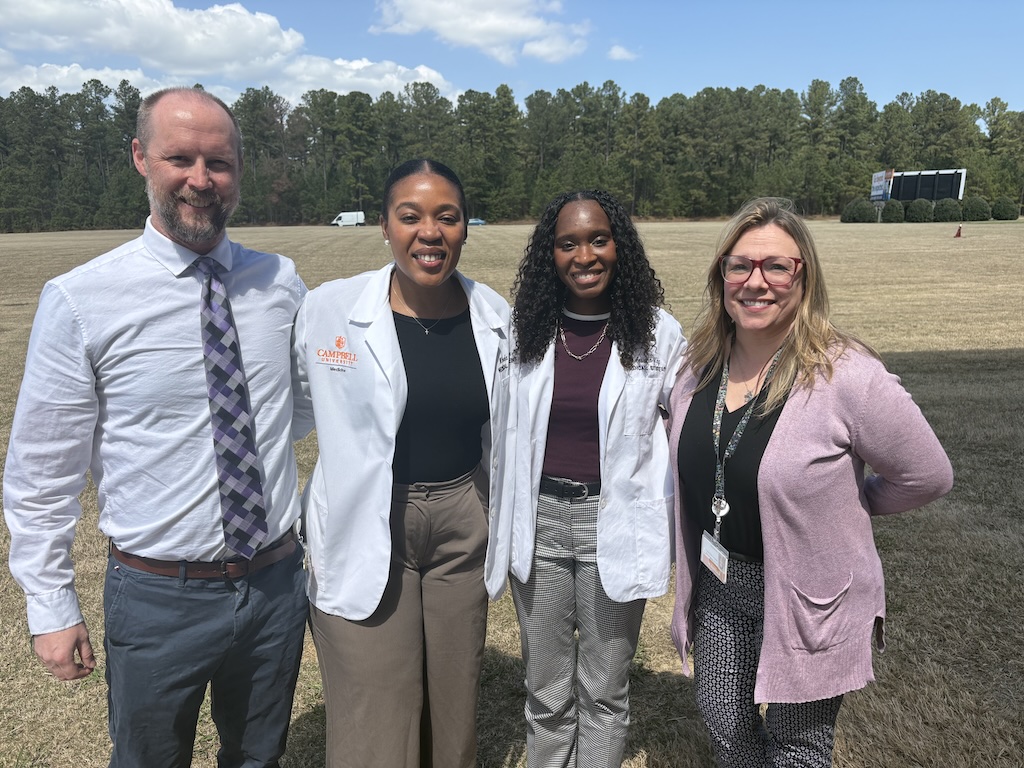

Two students from the Campbell University medical school are recipients of the prestigious NC Albert Schweitzer Fellowship and will work to fill a critical need for families in Harnett County.
The recipients, Michaela Brown and Jessica King, are second-year students in the Jerry M. Wallace School of Osteopathic Medicine (CUSOM). They are developing a plan to offer prenatal classes in partnership with the Harnett County Health Department, working there with Public Health Director Ainsley Johnson and nurse practitioner Melissa McLamb.
Brown and King are the first-ever CUSOM recipients of the Schweitzer Fellowship.
Founded in 1994, the NC Albert Schweitzer Fellowship is one of 13 currently active Schweitzer program sites across the U.S. dedicated to developing a pipeline of emerging professionals who enter the workforce with the skills and commitment necessary to address unmet health needs, the organization website says.
NC Schweitzer Fellows are competitively chosen from graduate health professional students enrolled at major NC universities and come from a variety of academic disciplines and, as Schweitzer Fellows, work tirelessly to address existing health disparities throughout the state, the site says.
The fellowship is just one positive outcome of the AERIMUS program at Campbell.
Dr. Brianne Holmes created AERIMUS. She is director and assistant professor of Professional Development at CUSOM.
That program, says Holmes, helps medical students grow into thoughtful leaders, advocates, and allies for the communities they will one day serve. AERIMUS is an acronym for “Advocating for Health Equity, Research, and Inclusion for Medically Underserved and Special Populations.”
The program is a selective Academic Enrichment program for students who have applied and have a proven track record in community volunteerism and outreach.
“Through a blend of learning, reflection, and hands‑on engagement, students explore social determinants of health, connect with local and regional organizations, deepen their understanding of health equity and inclusion, and practice the skills needed to support medically underserved populations, ” she says.
Students in AERIMUS work with Holmes to narrow down topic and project ideas, as well as outreach projects. The point of the program is giving students with project ideas a vehicle toward pursuing them with guided mentorship, says Holmes.
The AERIMUS program ultimately gives students a framework to connect what they learn in the classroom to the realities of clinical care and community needs, shaping them into empathetic, justice‑minded physicians. Along the way, Holmes says, they develop confidence as emerging professionals, learning how to champion their patients, collaborate across disciplines and prepare for opportunities like the Schweitzer Fellowship.
“We have so many students with really great community outreach ideas,” she says.
Brown and King are among them. Holmes worked to secure funding for the Schweitzer Fellowship, which involved a rigorous application process, including approval from the Dean’s Council.
In October 2023, Betsy Johnson Hospital in Dunn stopped providing labor and delivery services. It was the lone hospital in Harnett County to provide the services, with providers now opting to send patients to Fayetteville or to hospitals in Wake County or Durham, for example, requiring long drives for women to give birth.
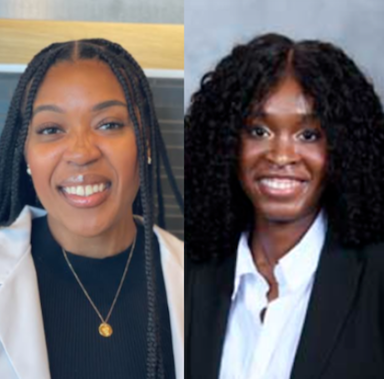
“We decided that it would be a good idea to form some kind of project that would assess the needs of the low-income population and the pregnant population here in Harnett County,” King says.
The Harnett County Health Department offers prenatal health services, but many pregnant patients don’t use the resources offered, King says.
She and Brown had an idea to help. The free, incentivized prenatal classes from the students are designed to inform pregnant patients — and the public in general — about the importance of prenatal care, clarify courses of action in medical emergencies and offer evidence-based practices to promote healthy pregnancies and healthy babies.
“Our goal is to bring in more patients to the prenatal clinic, to help patients get earlier care,” King says. “Because there’s not a labor and delivery unit here, a lot of patients aren’t coming to get care early on, in their first trimester.
“We’re gonna help encourage pregnant patients to get care earlier, and give them resources about what’s available here.”
Brown agrees. She says myriad factors led them toward starting the project, including racial disparities in maternal mortality.
“We’ve known for a while that black women are more likely to die during childbirth due to preventable factors that are not intrinsic to their race, including racism. And these adverse health outcomes have been exacerbated by these conditions … where we have rural hospital closures, rural labor unit closures and lack of provider access; a lack of general resources,” Brown says.
Black women in the U.S. died at a rate nearly 3.5 times higher white women around the time of childbirth in 2023, as maternal mortality fell below prepandemic levels overall but racial gaps widened, according to federal health data released early last year, PBS reported.
In 2021 and 2022, the maternal death rate for Black women was about 2.6 times higher than white women, PBS said.
A team of advisers and mentors, from throughout Campbell, will help guide them throughout the project.
Brown said being surrounded by a group of people who can brainstorm and work toward a goal is a distinct privilege and gives her professional advantage as she works toward becoming a practicing physician.
“We don’t have all the skills yet to practice medicine on our own, but there is absolutely something that you can do, even along the way. Hopefully, this is not just an encouragement for us … but more importantly an encouragement for the patients and the women that we get a chance to impact, because this is likely not the only challenge they face in their lives.”
Harnett County has OB/GYN physicians, but families with limited resources often seek care at the Health Department.
“There aren’t that many private OB/GYN providers that take Medicaid,” said Dr. W.H. Davin Townley-Tilson, an assistant professor of Physiology and Pathophysiology at the medical school and a faculty mentor for the project.
“It’s an expensive thing.”
Another focus of the project, using qualitative and quantitative data, will look at who uses the Health Department clinic and, then, their clinical outcomes. People with more resources can afford to travel to Wake County, for example, to seek prenatal care throughout the process,Townley-Tilson says.
The research will include about 15 OB/GYN doctors, as well as physicians at the Health Department, to gather and analyze the data.
What’s the impact associated with closing Betsy Johnson? Where do expectant mothers go, especially during their late term, and who do they call?
Clinically, who do you go to? Towney-Tilson asks.
“What do you know about the hospitals in Fayetteville? Who do you call if something happens clinically? Where do you get a car seat? Where do you get formula, WIC or SNAP benefits?
“It’s a big problem,” Towney-Tilson says.
An issue, too, is making people aware of the prenatal classes, which is important for expectant families and available from the Health Department. The idea of “community” is a major focus toward visibility.
“They wanted more community amongst other mothers, other first-time parents, and so this is definitely going to provide that avenue, as well,” says Brown, referring to the Health Department.
The first resource that the vast majority of these women actually have is each other, Holmes says.
“The project is focusing on those women that are not getting the care,” she says. “So, where they turn first is to each other, especially in a community that a lot of women feel like has abandoned them.”
Brown is from Silver Spring, Maryland, but has family in Eastern North Carolina. She knows about the myriad problems for residents trying to access healthcare. She and King want to increase awareness about the problems and to turn their attention toward patients looking for answers, in this case about prenatal care.
“This is something that has been impacting this community for a while, and people an hour away, or right down the street, don’t know about it,” she says about the prenatal training.
People in Harnett, King says, may feel as if they don’t have the access or the means for prenatal care.
“I’m very interested in doing maternal health, and I know (Brown) and I, as Black women … that’s a prominent demographic in rural communities,” says King, of Tampa, Florida. “This is a nationwide thing, where hospitals are shutting down in rural communities, and they’re not having anywhere to go to deliver their children.
“No matter where we go, we’re going to find populations and demographics who are struggling with the same thing, whether it be maternal patients or other patients who are dealing with a lack of health care and a lack of access to health care. I think the skills that we’re learning now are going to be valuable to apply as physicians.”