


Type 2 diabetes, if not treated properly, can have crushing effects. On individuals, families, communities.
Whiteville High School nurse Paula Inman-Nance sees the problem every day. In her community. In students at all five city schools. In their parents.
“We have diabetic students in all of our schools,” she says. “We have five schools in the Whiteville City Schools system. … We have Type 2 diabetes in the lower grades, too. And we’re seeing more and more every year.”
Inman-Nance, with the help of students from the Campbell University medical school and a local physician, through a pilot project are taking a novel approach toward addressing the problem.
Diabetes is the seventh-leading cause of death in both the U.S. and North Carolina, and Type 2 diabetes accounts for about 90 percent to 95 percent of all diagnosed cases of diabetes, according to the website Diabetes NC.
Further, cases of Type 2 diabetes in people 10-19 in the U.S. are rising fast, the Journal of Health Economics and Outcomes Research says. Since 2002-03, overall diagnoses have doubled — from nine per 100,000 youths to 17.9 per 100,000 in 2017-18. If those rising rates persist, the number of type 2 diabetes cases in young people is projected to “skyrocket from 28,000 in 2017 to 220,000 by 2060,” the outcomes group says.
Dr. Peter Chambers is an emergency department physician in the Columbus Regional Healthcare System (CRHS) in Whiteville, which last year became one of the newest clinical training sites for students in the Campbell University Jerry M. Wallace School of Osteopathic Medicine.
Chambers, director of medical education for the new clinic, was speaking to the Campbell students as part of the didactic portion of their training. A big part of the mission for Campbell’s medical school includes serving the underserved, reaching deep into Southeastern North Carolina’s rural communities to offer compassion and care.
That mirrors Chambers’s approach, and a common theme of the teaching sessions with med students is this concept of community health, comprising patients and families.
The class was talking about health screenings, at one point focusing on diabetes. Screening for that potentially life-threatening disease, Chambers says, costs relative pennies.
“Spontaneously, in the classroom, I said, ‘We should do a study, and let’s just do a study as a class. I’m gonna turn it over to you. This is what I’m looking for. This is what we should do,’” says Chambers.
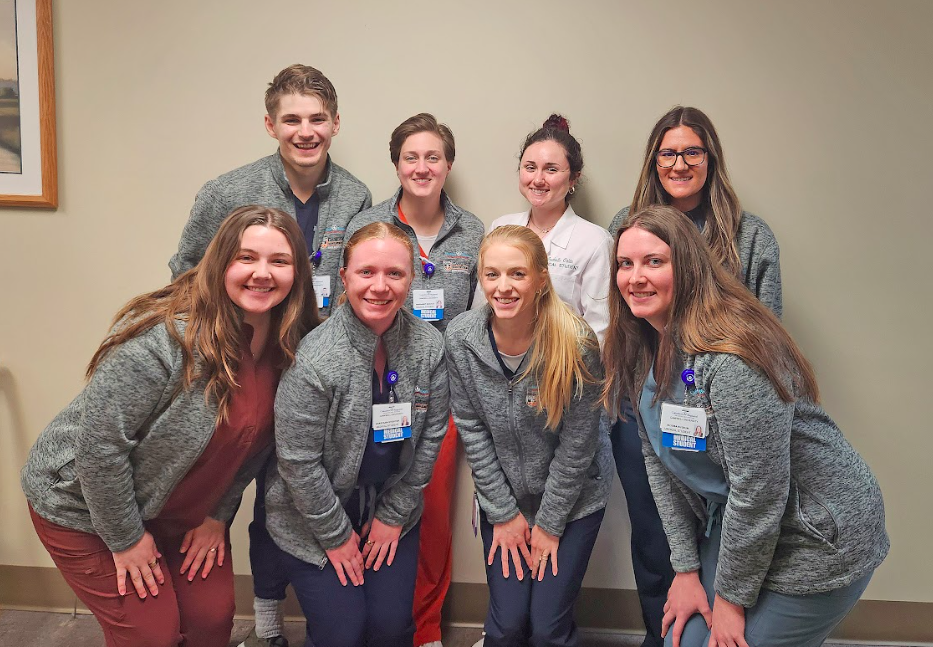
The Campbell third-year med students, 11 in all, took it from there. They created a proposal to screen students for diabetes and submitted their idea for a pilot program to the school district.
Inman-Nance immediately jumped on board.
In 2018, Diabetes NC says, diabetes was the primary cause for 3,021 deaths — 3.2 percent of all deaths — and a contributing cause to many more deaths in North Carolina. Healthy eating, physical activity and prescribed medication can help people manage their diabetes.
Work on the Columbus screening project began in November, and the school board approved it the next month. The district began sending home consent forms with students that week for the districtwide glucosuria screening, says The New Reporter of Whiteville. Students who return consent forms signed by a parent can participate in the urine screening, which is scheduled for Feb. 18, the paper said. If any risk factors for diabetes are found, parents would be informed and offered the appropriate resources toward seeking further treatment. Participation is voluntary.
Inman-Nance counsels children and their parents about the disease. She tells them about the dangers, the long-term effects. Oftentimes her words aren’t loud enough, the message muddled, forgotten and ultimately lost.
That must change, she says.
“Many of our students who have presented with diabetes … have had it for a long time before they even knew it,” Inman-Nance says.
The goal of the glucose screening is to reach every student, and education is key, she says. That includes working to educate parents, as well.
Inman-Nance has placed posters around the school trying to teach the students about diabetes. She has visited every classroom at the high school and has even offered gift cards to entice students to get screened.
It’s a challenge, says Inman-Nance, who lauded the effort by Chambers and the Campbell students for their help and innovation.
“What an amazing group of people,” Inman-Nance says. They are going to definitely make a difference in (people’s) lives one day.”
The Campbell students are: Luke Deberny, Margaret Monaco, Isabella Colon, Alexsandra Cvetkovska, Alyssa Russum, Kaitlyn Stocks, Anastasia Stitcher and Kendall McKnight. Not pictured: Zack Cline, Alex Lafferty and Sayyidah Ali.
“They have been a joy to meet and be around … the future is bright. Maybe some of them will come back … and work in our area.”
Other efforts to reach out in the local community are ongoing, and Campbell students are playing a big role.
Barbershop talks are just one example of Chambers’s work in the community, now with the help of the Campbell students. The project revolves around area barbershops, which are a sort of gathering place, particularly in the African-American community.
Chambers, with CRHS chaplain Jeremy Simmons, bought blood-pressure cuffs to the barbers, who were trained to use them on their clients. If the number is high, the barbers offer a card that includes information about treating hypertension and where to go for help.
Inman-Nance, too, had high praise for Chambers, an osteopathic physician, “because he really cares about the community, and especially kids.”
The glucose screening won’t necessarily lead to a diagnosis, but it could reveal key markers indicating the need for further evaluation and treatment. The goal is to catch the disease to help prevent a dangerous outcome, Inman-Nance says.
The effort is ongoing.
“It’s, ‘What else can we do? What more can we do? How can we catch things early? How can we try to prevent this, reverse this, if possible?”