

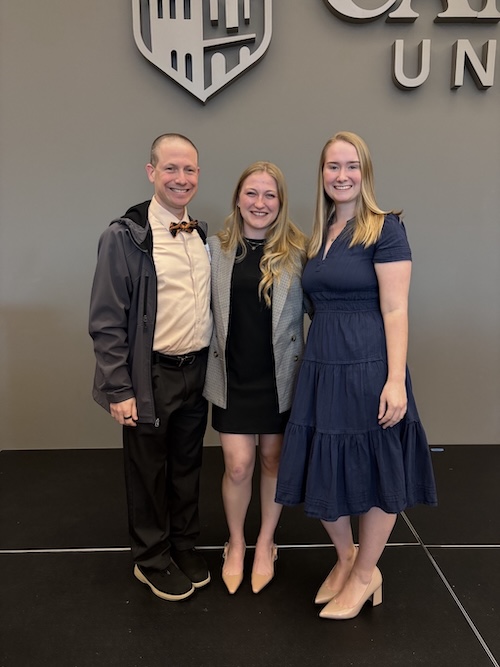

Conventional treatments aren’t fully meeting the needs of chronic pain patients, student Dr. Kyle Agostini says.
Many, then, turn to complementary approaches on their own.
“What stood out to me most was osteopathic manipulative treatment (OMT),” Agostini says. “Despite having the strongest statistical association with chronic pain of any physical approach we studied — and high patient satisfaction among those who used it — OMT remains largely unknown to the general public.”
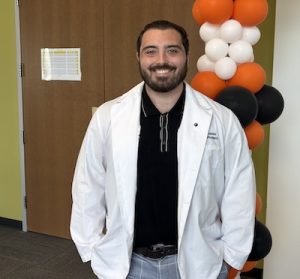
Agostini earned High Merit for the Online Video Presentation for his research — “The Association of Chronic Pain and Complementary Health Approach Usage: A Comprehensive Analysis Adjusting for Demographics.”
Agostini was one of a group of students from the Campbell University Jerry M. Wallace School of Osteopathic Medicine, who joined students from throughout the university, to earn honors as part of the Wiggins Memorial Library Academic Symposium on Tuesday, March 24. Medical school faculty mentors played important roles in the student projects.
Receiving High Merit for graduate-level Poster Presentations were Desiree Byrd, Maria Echeverri and Alyson Kidd for “An Overview of Appendiceal Mucinous Neoplasms: Histopathological and Clinical Implications.” Dr. Alan Proia, professor and clinical chair of Pathology, and Dr. David Green, professor and chair of Anatomy, were faculty mentors.
Also receiving High Merit in that category were Hannah Ruiz, Madison Lawrence for “A Case Study: Hydronephrosis with a Review of Possible Causes.” Dr. Bonnie Brenseke, assistant dean, Biomedical Affairs, as well as Dr. Terence Mitchell, director of the Gross Anatomy Lab, served as faculty mentors.
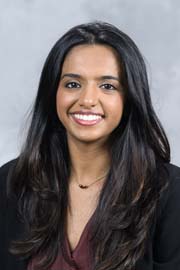
First-year student Dr. Riya Nitesh Shah earned High Merit for “Building a Diverse Health Workforce: A Demographic Analysis of a Rural FQHC Medical Scribe Pipeline,” with Dr. Jan Lee Santos.
“I was drawn to this research because of my experience working in a rural Federally Qualified Health Centers for three years, where I saw firsthand how workforce shortages directly impact patient care, clinic flow and provider burnout,” Shah says. “This project allowed me to explore a sustainable, equity-focused solution by investing in trainees from underrepresented backgrounds and creating a structured pathway into healthcare careers.
“Through this work, I learned how powerful it can be to integrate workforce development into everyday clinical operations — not only improving efficiency, but also fostering mentorship, continuity and a stronger sense of community within the care team.”
The research, she says, also highlighted how relatively low-cost, scalable interventions can have a meaningful effect on workforce sustainability and health equity.
“As I continue my training as a medical student,” Shah says, “I hope to carry these lessons forward by actively engaging in mentorship, advocating for pipeline programs and helping design systems that support both learners and providers in underserved settings. Ultimately, I aim to be part of building a more diverse and resilient healthcare workforce that can better meet the needs of all communities.”
See the full list of symposium honors here.
As part of a research fellowship, Agostini, a third-year student at the Campbell med school, says he worked with Dr. Thomas Motyka to design and deploy a nationally representative survey examining how chronic pain patients use complementary health approaches.
Motyka is chair and associate professor of Osteopathic Manipulative Medicine and associate professor of Internal Medicine at the med school.
“When the data came back from over 3,000 respondents, I built a statistical analysis pipeline from the ground up — one that could be adapted for future research projects beyond this study,” Agostini says. “That process pushed me to develop a much deeper understanding of epidemiological methodology than I’d had before.”
Receiving Merit in graduate Poster Presentations were Student Drs. Olivia Knaus, Garrett Farringer, “A Case Study: Mesenteric Lipoma with a Review of Contributing Factors” (Faculty Mentor: Dr. Adam Foster, Associate Professor of Anatomy, and Proia were faculty mentors.
Also receiving merit in that category was student Dr. Kaitlyn Stocks for “A Patient with a Rapidly Progressive Pustular Eruption after Treatment of a Cyst.” Dr. Phuong Daniels,
Student Drs. Emily Wernsing and Bailey Wells earned Merit in Oral Presentation for “Ibogaine Treatment for TBI and Associated PTSD.”
Traumatic brain injuries, TBI, are common in military populations who also suffer from post-traumatic stress disorder, PTSD. Veterans who have TBI and PTSD can endure substantial sequelae, and finding symptom relief leads to improved quality of life, Wernsing’s and Wells’s research finds.
“We presented a case report about a veteran patient to help people better understand an alternative method for treating traumatic brain injuries and post traumatic stress disorder,” Wells said. “Our patient interview discussed his success with a psychedelic drug therapy called Ibogaine and allowed us an inside view of his world and improvements.
“Although it is considered a Schedule 1 drug in the United States and is not currently legal to prescribe, many veterans —such as this one — are seeking treatment facilities outside the U.S. to find symptom relief.”
The two-day academic symposium featured nearly 200 undergraduate and graduate students, who were mentored by some 75 Campbell professors over the two-day event.
Dr. Robert N. Agnello, chair of Family Medicine and assistant Professor of Family Medicine, at Campbell, mentored Agostini, Wells and Wernsing on their projects.
Agostini says his findings tell an important story.
More than 50 million adults in the U.S. are living with chronic pain, his research finds, and 97.4 percent of chronic pain patients use at least one complementary approach. Further, people with the pain are 2.4 times more likely to seek complementary care versus those without chronic pain. Fifty-one percent of those people turn to supplements, and 44 try mindfulness. Others turn to massage and chiropractic therapy, for example.
OMT is the underutilized standout, he says. It has lowest absolute usage — but the strongest association with chronic pain of any physical approach studied. The research found that 81 percent of OMT users with chronic pain reported a favorable experience with OMT, and that OMT ranked first for the strongest adjusted odds ratio among all physical approaches.
“My hope is that this work helps put OMT on the map as a legitimate, evidence-supported option for chronic pain, and encourages future research that matches its visibility to its actual potential to help people.”
The symposium was part of Inauguration Week for Campbell President Dr. William M. Downs, who delivered the keynote address before the symposium awards ceremony.