

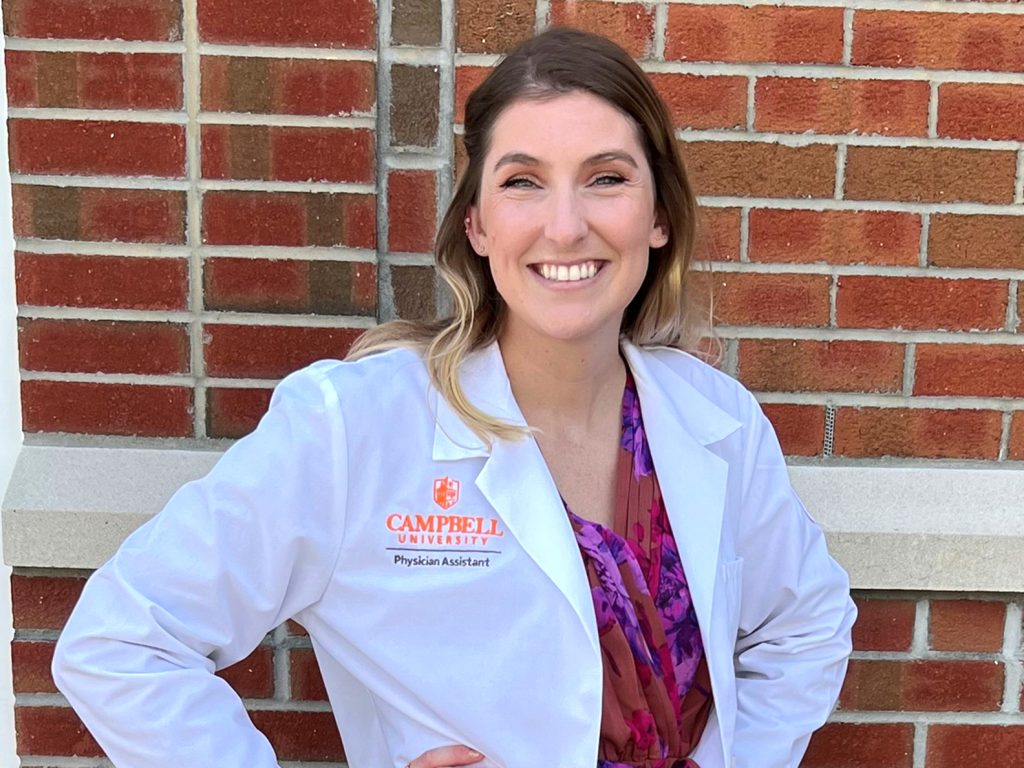

When Alyssa Price, a second-year student in Campbell University’s Physician Assistant program, began her surgery rotation at UNC REX Healthcare last fall, she expected to sharpen her clinical skills.
She did not expect her artistic talent to become part of an internationally published case report.
Several months before her rotation began, a surgical team at UNC REX Healthcare treated an extraordinarily rare condition known as partial hepatic volvulus, sometimes referred to as a “wandering liver,” which resulted in acute biliary obstruction. While preparing for exams and upcoming surgical cases during her rotation, Alyssa created detailed anatomical drawings as part of her study process. After seeing her work, members of the surgical team asked if she could create a medical illustration to accompany a manuscript describing the rare case.
The report was later published in BMJ Case Reports, a journal previously known as the British Medical Journal, as “Partial hepatic volvulus and acute biliary obstruction” by physician assistant Braden Allred and surgeon Michael LeCompte.
Recognizing the complexity of the anatomy involved, Price used her iPad to carefully draw the rotated liver and torsion of the common bile duct, helping visually explain the rare presentation described in the article. Her illustration appears as Figure 6 in the publication.
“I love being able to combine art and medicine,” Price said. “Drawing helps me understand anatomy on a deeper level, and it was incredibly meaningful to know my work could help others better visualize such a rare condition.”
Although the published article did not formally credit her illustration, faculty and classmates know the talent behind the image.
Dr. Laura Gerstner, chair and program director of the Physician Assistant Practice program, praised Price’s contribution.
“Alyssa demonstrates the clinical excellence and innovation we are proud to see in our students,” Gerstner said. “Her creativity and willingness to contribute beyond expectations demonstrate the kind of well-rounded professional we strive to graduate. We are incredibly proud of her.”
The case report details how the patient’s liver rotated along its axis, causing torsion of the bile duct and acute obstruction, a complication not previously reported in modern literature. Price’s illustration plays a key role in helping readers understand the anatomical changes involved.
For Price, the experience reinforced the value of interdisciplinary skills.
“Medicine is both science and communication,” she said. “If my drawing helps another provider recognize something rare or understand it more clearly, then that’s the greatest reward.”
As she continues her clinical training, Price carries with her not only growing medical expertise but also the unique ability to bring complex anatomy to life through art.