

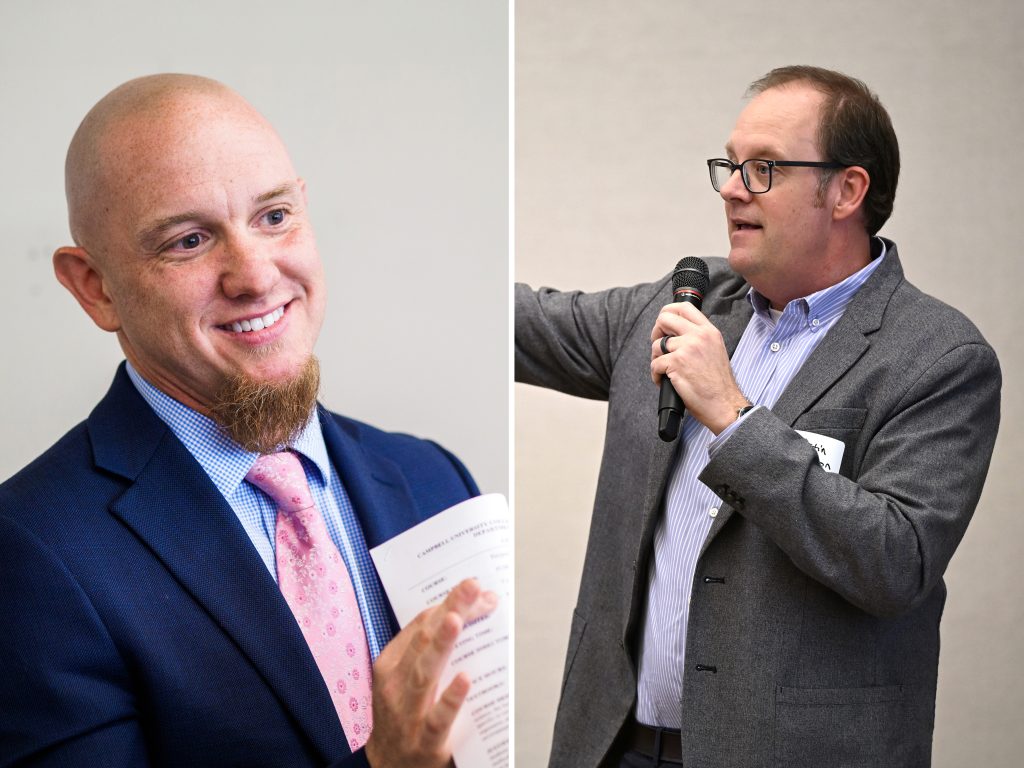

As rural areas deal with the onset of large, energy-intensive data centers to meet the country’s artificial intelligence and cloud computing demands, two Campbell University professors are challenging the industry’s use of a word they hold dear to them.
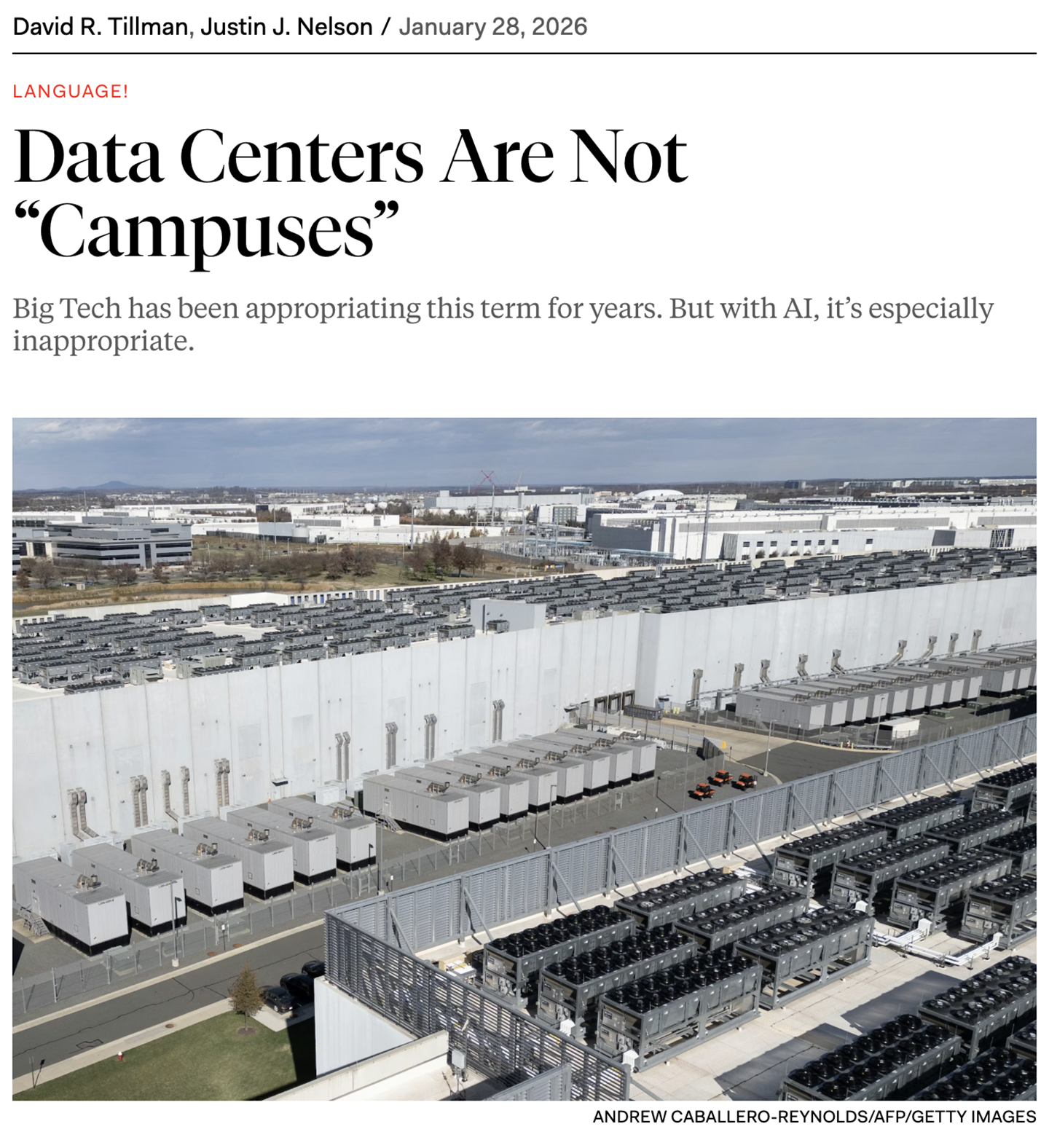
Dr. David Tillman, professor of public health, and Dr. Justin Nelson, associate professor of sociology, co-authored the article, “Data Centers Are Not ‘Campuses,’” published on Jan. 28 by The New Republic, a prominent U.S.-based monthly magazine and daily online platform focusing on politics, culture and the arts. In the article, Tillman and Nelson challenge companies like OpenAI, Oracle and AVAIO Digital and their use of the word “campus” to describe their new multi-billion-dollar data centers in Michigan and Arkansas.
“None of these projects resemble anything most people would recognize as a campus,” they wrote. “These are industrial facilities designed to house computation at scale. … They are typically insulated from the surrounding community, both physically and economically. To call them campuses is ridiculous — unless, of course, the point is to provide the sheen of civic legitimacy, obscure how few humans are actually involved and gloss over questions of the true public value of these operations.”
Nelson has become a national voice on the social implications of artificial intelligence. In 2025, he co-authored the book Society Without People with Baylor University sociology lecturer Dr. Christopher Pieper, where they seek answers to “preserving human dignity” in a world increasingly mediated by machines.
Tillman has been a longtime advocate for rural health, having consulted with health care systems, local health departments and state governments regarding strategies to improve health in underserved areas. Recently, rural areas in nearby Lee County and Cumberland County have been eyed for future centers — a single center can draw enormous amounts of energy and water (one center can use as much power as 200,000 North Carolina homes, according to the U.S. Energy Information Administration).
According to Tillman, this makes AI and the facilities that power it very much a public health and rural health issue.
“If you’re concerned about ‘rural,’ then you’re concerned about land use,” Tillman says. “You don’t have to be a ‘doomer’ about AI to understand that with that kind of power, we should be cautious. There’s caution in both AI’s end uses, but also in the infrastructure that is required to make these things happen.”
Tillman quoted novelist and environmental activist Wendell Berry, who once said he wasn’t anti-technology, but rather “pro-community.”
“I care so much about these communities, particularly rural communities in our state, that when I see a potential threat to the well-being of those communities, I feel we have a responsibility to call that out,” Tillman adds.
Their article focuses strongly on the industry’s use of the word “campus,” a word that has grown to describe “a place ordered toward people engaged in shared work” — much like the university the two work at or a hospital where healing and teaching are at the forefront. A data center, they write, does not gather people — “these buildings typically occupy hundreds of thousands of square feet on hundreds of acres of land while supporting only a few dozen permanent workers, many of them contractors, with most operations managed remotely.”
“Campuses contribute to human flourishing,” Nelson says. “And I just don’t see that in the examples of data centers. They aren’t serving the people and communities in which they’re humming.”
Nelson says the article is part of a budding “partnership” between himself and Tillman, as well as Campbell’s sociology and public health departments.
“It’s great to be at a place like Campbell where we can join forces and be advocates for the places we live, work and serve.”
Read the full article, “Data Centers are Not ‘Campuses’” at The New Republic.