
“Please don’t let me die out here.”
The words hit hard, as if turning a blind corner and walking head first into a concrete wall. The simple sentence will forever resonate with the Campbell student doctors, faculty and volunteers who heard them from a man seeking care.
“Don’t let me die.”
Sometime later, on a hot August day, a Campbell University van is parked on an asphalt lot, near a patch of thick, poison ivy-infested woods not far from the medical school, as well as a large regional hospital.
A group of Campbell student doctors fill the back seats of the van. Dr. Joe Cacioppo, chair of Community and Global Health, is in the front passenger seat; Christina Phillips of Blessingway in a row behind him.
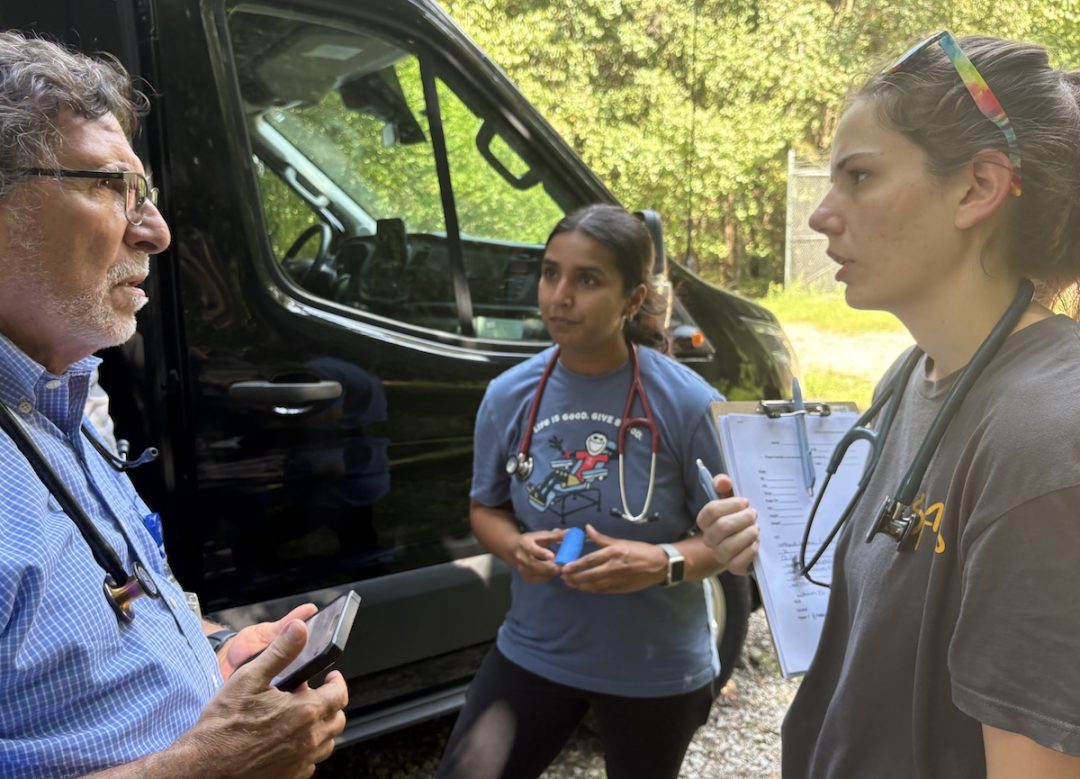
Dr. W.H. Davin Townley-Tilson, who was driving, Phillips and Cacioppo step out of the van. A handful of students follow. They look across a busy highway before turning their focus to the woods and heavy brush.
“Is he here?” someone asks.
He is.
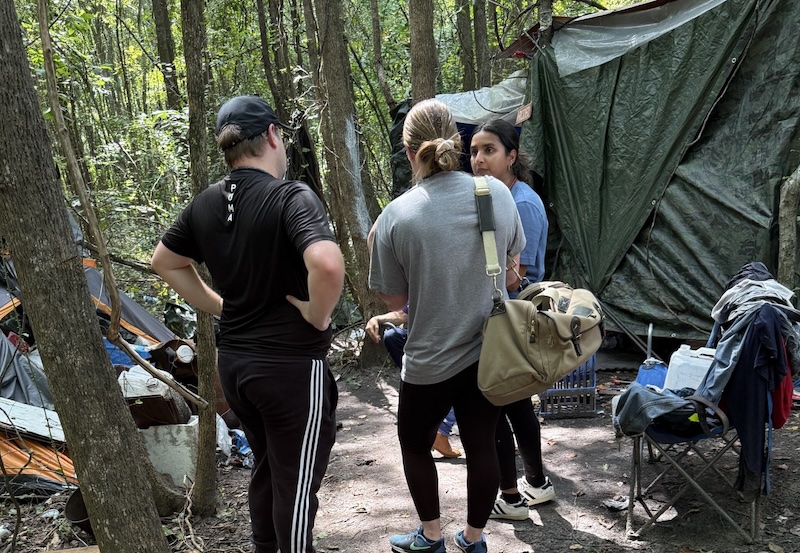
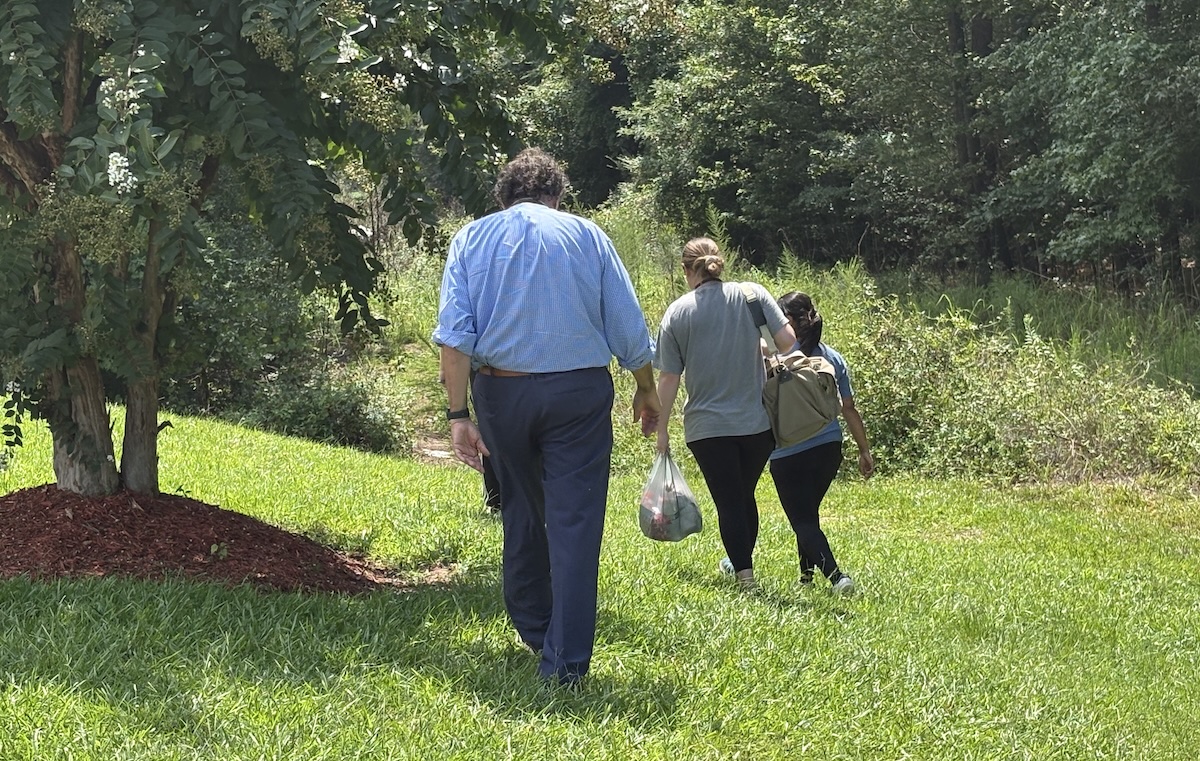
A middle-aged man, wearing a T-shirt and jeans, appears from the direction of the highway. He knows them, and they know him. For a few seconds they talk. Together, the student doctors, armed with medicine and water, head toward the trees and overgrowth. Toward the man’s makeshift home.
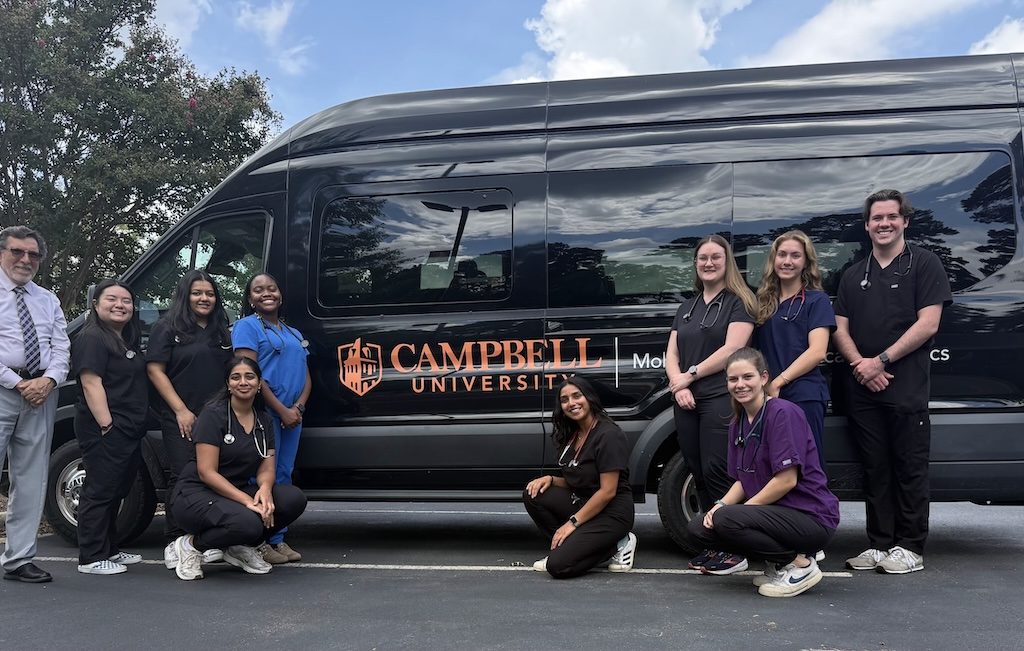
The Campbell University Street Medicine initiative, an outgrowth of the Community Care Clinic, is run by students, who oversee and drive the program, albeit with some faculty oversight.
The program reaches deep into the community to help those in need, bringing healthcare, water, necessary medications, toiletries and other supplies. Making relationships and scheduling follow-up visits. To people, for instance, who need healthcare but, for whatever reason, have no means to access it.
This student-run initiative began with now-third-year student doctors Veronica Butler and Judy Mourad.
Butler was raised in California and attended the University of California-Santa Barbara (UCSB). She became keenly aware of the homeless problem in that state and approached Cacioppo, chair of Community and Global Health at Campbell, about instituting a similar program in Harnett County after coming to Campbell.
“She started this,” Cacioppo says. “She started the whole thing.”
Butler was introduced to the concept while at UCSB, which has a student-led street medicine team, Doctors Without Walls.
 At Campbell, her faculty adviser, Townley-Tilson, an assistant professor of Physiology and Pathophysiology, agreed to explore the idea and to help however he could.
Butler visited a homeless shelter in Harnett County, and she posed a question: “What happens if they can’t stay here? Is there anywhere else they can go?”
“The answer,” Butler says, “was essentially that people are staying in the woods. OK, well, it looks like perhaps street medicine could be something that people need here, and that’s kind of how the project started.”
Mourad, Butler says, was one of her first friends in North Carolina, and she eagerly jumped in. With the help of people like Phillips they began identifying those who needed help, conducting a community needs-based assessment, learning what was available … and what wasn’t.
“Judy and I founded the program and spent the past two years building it from the ground up, from developing the initial program structure and outreach model to establishing partnerships, workflows needed to get the team into the field and keep it sustainable,” says Butler. She talked about Dr. Jim Withers, who, Butler says, began providing medical care directly to people living on the streets of Pittsburgh in the early 1990s.
“At its core, the model is about going to the people, meeting people where they are and providing care on their terms, with dignity, respect and without judgment. Street Medicine has since grown into a global movement practiced by people of many different faiths and backgrounds.”
As third-year student doctors,Butler and Mourad, of the Raleigh area, are doing their clinical rotations in Wake County, so they now have taken on advisory roles with the Street Medicine program. Second-year student Drs. Megha Pb and Sindhoor Ambati run the day-to-day operations, as executive director and associate director, respectively.
“They have done an incredible job, not only continuing what was built but strengthening the program, developing systems and workflows and helping it grow so we can reach more people,” Butler says. “The program’s continued success really reflects their leadership and commitment; it would not have been able to continue without their passion to serve the community.”
Before Campbell, Pb volunteered in wound care at the N.C. Harm Reduction Coalition, where she met her first patient. The patient’s face was cut, her eyelids swollen. She told Pb she was just released from jail and, soon after, she was in a car wreck.
“As I cleaned her wounds, we built a connection, and I asked if she was open to going to the ER. She said she would ‘rather be a goner than step into a hospital again,’” Pb says. “She had many concerns preventing her from receiving care, such as the stigma she may face due to her history of substance use and incarceration. Her relationship with medicine was complicated, and her firm decision to avoid care, regardless of her condition, left an impact on me.
A lack of trust in the medical system keeps people like that patient stuck in a vicious cycle, Pb says.
“I became motivated to learn as much as I could to try and create bridges between those that feel unsafe seeking care or left behind and the systems created to help them.”
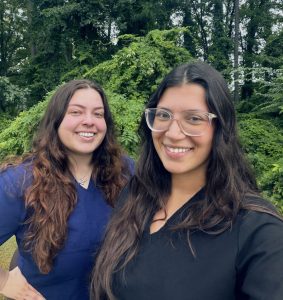
Butler, Pb says, is someone she was meant to meet.
“We connected at length over our shared passion for meeting people where they are and delivering care and resources to them directly, in hopes of chipping away at the barriers between them and their medical care,” Pb says.
“In medical school, it can be easy to lose yourself among the hundreds of powerpoint slides and textbook pages. Being able to work at this clinic, to hear directly from patients about their fears, and to have the opportunity of finding ways to alleviate them is the most grounding experience. This is why we are here. Why we want to be doctors. That’s what motivates me to keep going.”
Nobody teaches you how to be homeless
“Where did street medicine start?” asks Townley-Tilson. “Within the Christian faith. This is the original street medicine. …, he told medical school staff and faculty during a meeting this summer.
Jesus didn’t ask, “Are you insured? Do you have a house?
“Remember, nobody teaches you how to be homeless. Nobody raised their hand in kindergarten to say, ‘I want to be homeless when I grow up.’ Everyone has a story … that’s different. People don’t want to be sick, and for the vast majority, they don’t want to be out there.
“This is not a choice. It’s not a behavior.”
Caring for the homeless means meeting people, regardless of where or how they live.
In this case, on this steamy August afternoon, it’s in a tent, tucked far out of sight along the busy highway. The care team emerges from the heavy growth, this time without the supplies but with a vial of blood, which they’ll send to a lab. They’ll return later, to treat him again. Assuming he hasn’t left. Assuming he hasn’t been arrested, or driven off for trespassing. Assuming no one has taken his possessions while he was away. While he was walking along the highway. Looking for food, for water.
The mobile and freestanding clinics, part of the Jerry M. Wallace School of Osteopathic Medicine, provide cost-free healthcare to underserved people throughout Eastern North Carolina.
The Community Care Clinic is funded through myriad grants, yet it also largely relies on private donations and other support, such as fundraising events. The clinic offers free visits, lab work, imaging and medications to people who would not otherwise have access to health care, on campus and via mobile medical units. The clinic sees only uninsured patients, living at or below 250 percent of the U.S. poverty line.
The volunteer-based clinic, established in 2014 within the med school, is composed of physicians and physician assistants who oversee teams of medical, physician assistant and pharmacy students. The first year of the clinic, the Campbell teams saw 237 patients. Last year they surpassed 1,700.
Cacioppo is medical director on the Street Medicine project. Butler also thanks people such as Cynthia Lee, assistant director of Community and Global Health, and Kristin Johnson, administrative director, among many others, for their help and guidance.
“We’ve also been very fortunate to have faculty and clinical support … ,” Butler says.
The Street Medicine team started seeing patients in October 2025. Trying to, anyway. Some people were afraid to receive treatment, because they didn’t know the students well. They had yet to establish that all-important trust.
“We weren’t very well established in the community yet and, of course,this is a very vulnerable population,” Mourad said. “Just building that trust, that was important.”
One of the biggest challenges, Butler said, was finding the people who needed care. People willing to receive it.
One day Butler saw a man. He sat at the side of a Harnett County road, and he held a sign.
“I pulled over to talk to him, and he talked about some of the difficulties in the county. He was trying to get his ID and, obviously, you need your ID to get certain services. And then I kept following up with him.”
Word got around, and the team found more patients. More people who needed help.
A team of paramedics and nurses from Harnett County Emergency Medical Services has, too, joined Campbell in the community initiative.
“They have a lot of valuable information, and they also are out every day looking (for people),” Cacioppo says. Campbell also is partnering with several Wake County agencies and will soon bring a mobile medical unit to the state capital, treating that city’s homeless population, some 400 people.
Importantly, the Campbell clinics partner with local nonprofits and 501(c)(3) organizations, such as Phillips’s Blessingway, which offers food, clothes, household items and outreach services to those who need them.
Phillips, truly a proud mom, doesn’t want accolades or publicity. She wants only to help. She doesn’t advertise, operating mostly “underground,” she says, relying on “word of mouth” to promote her services. Making people aware of them.
“She’s gotten to know many of the homeless, and then the team has gone out to several locations and was introduced,” Cacioppo says.
Says Mourad, “Another big component to this, outside of medical care, is the social aspect.”
The team can provide medicine and food. Clothes and toiletries. But, Mourad asks, how can we make sure the patients are cared for in the long-term? That they continue to take their medicine? That they’re getting the proper food and nutrition?
“(Phillips) has been a great help in meeting them and giving them the resources that they need, and that’s very tailored to each patient that we see,” Mourad says.
A passion, and a mission
Phillips says she grew up “very poor,” in a time when food pantries and churches didn’t regularly distribute food.
“I told my husband that if I was ever in a position to help, I would. We still live below poverty — three people on one income, but we have dedicated our lives, as of right now, to helping folks who have less than us. We’ve learned over the years how to live on a limited income and how to cook out of cans, so I try to pass that knowledge along.”
Building a community in which people help one another, help to sustain one another, is part of the mission, Phillips says.
“Everyone who is part of the community contributes to those who are in need, and those who are in need feel confident in asking for help.
“Since I’m new, small and don’t advertise, getting referrals, food donations and basic needs met for folks can be challenging, because folks don’t know me yet to trust me and don’t know I’m around to donate to. However, folks who do know me know that if there’s a will, there’s a way, and I find that way.
“The hardest part for me is understanding that not everyone likes me, likes what I’m doing and is voting for me to succeed. Folks would rather call the police and have the houseless moved from where they’re living than to take the time to get to know them.”
The group has a Facebook page, but it’s a place where people can’t charge for goods and services, nor can they ask for money.
“This way, people are getting out, getting involved in their community and building relationships.”
Phillips provides for basic needs, such as food, toiletries, hygiene items, cleaning supplies, tents and clothing. Things such as socks, batteries, flashlights and pet food.
“I also help find low-income housing if there is an income outside of government aid. I also help folks set up Medicaid and SNAP benefits. I have helped folks get their driver’s license, taken them to shelters. I’m an emergency contact for a few folks, I help them find jobs and try to help be a liaison so that they can move back into society,” she says.
She counts on others referring people to her who need help. She leaves business cards in “Blessing Boxes,” at schools and other places people might see them.
“I pretty much am recommended based on trust and word of mouth. I stay under the radar because I feel like this is the most vulnerable population, and anything I do and say can put them at jeopardy.”
Looking, watching, helping
From one of the van’s passenger seats she scours the roadways. Always watching, always looking for someone she knows. Someone who may need help.
The most underserved of the underserved, says Townley-Tilson, who earlier this year attended a Street Medicine Institute Symposium in California, where he met with healthcare professionals and other providers to learn more about the issue of homelessness in the U.S. The institute, its website says, facilitates and enhances the direct provision of health care to the unsheltered homeless where they live. In California, Butler volunteered with a University of Southern California Street Medicine team, whose founders are also part of the Street Medicine Institute.
Withers, the Street Medicine Institute website says, sensed a burning desire among practitioners to come together and share insights and for mutual encouragement. The International Street Medicine Symposium was founded in Pittsburgh in 2005, followed by now 15 more successful annual symposia in cities across the U.S. with more than 1,000 total participants from around the world sharing best practices, learning new skills and strategies and validating the ideals of their common work on the streets, the site says.
The Campbell team, Butler says, is part of the Street Medicine Institute, Student Coalition.
Nearly 22 out of every 10,000 Americans — 745,652 people — experienced homelessness in January 2025, according to the Department of Housing and Urban Development annual point-in-time report, which measures homelessness across the U.S. on a single night each winter. That’s a 3.3 percent decrease from 2024’s count, nationally.
But North Carolina saw one of the largest increases in the country, with 15,512 people experiencing homelessness. According to the 2025 data, homelessness in North Carolina increased by some 33.4% — to 3,886 people —between 2024 and 2025, making it the largest percentage increase among all states and the second largest numerical increase, after only Oregon, says HUD. Last year, California counted 181,934 homeless people — the highest in the nation — though that number marks a nearly 3% drop from 2024, nonprofit Cal Matters says.
Further, the average life expectancy for a person experiencing homelessness is between 42 and 52 years old — roughly 15 to 30 years shorter than the general population, according to the University of Pennsylvania’s Leonard Davis Institute of Health Economics.
It’s tough, if not impossible, to compare Southern California with Harnett County, for many reasons, though homeless people living near Campbell must navigate similar barriers, including policing, stigma and difficulty accessing resources and healthcare, Butler says.
Fewer resources
“The biggest difference is that individuals here are much more geographically dispersed, with fewer resources,” she says.
Homeless people are often in one place one week, somewhere else the next. Oftentimes wondering where they will sleep. What, if anything, they will eat.
“We park a bus or a van on a corner. … and we do medicine,” Townley-Tilson says. “Maybe we’ll see one (person), maybe we’ll see three. We don’t know. Maybe they get swept up. Maybe they’re too sick to come out. Maybe they don’t want to come out because they’re scared.”
These people often avoid emergency rooms, until their health situation leaves them with little choice. They know that, if they’re treated, they’ll be released and return to … where?
“One of the goals of Street Medicine is to provide primary and preventive care earlier, before something becomes an emergency,” Butler says.
Sometimes law enforcement conducts “sweeps,” displacing homeless people from encampments, where they live and where they keep any items they may have. Sometimes, if they’re away too long, others come and take what they did have.
“If they leave their encampment, their stuff will get stolen. We have to go to them on their terms, meet them where they are — emotionally, physically, medically.
“We’re out there after dark, because oftentimes we’re the only people that these people trust, and they want to talk to us, and they want us to help them with transportation, with food,” Townley-Tilson says.
“Many of them have jobs. Many of them have been homeless for over a decade, but they don’t trust anybody else. We don’t show up to a parking lot, have people come to us. We go to them.”
Sometimes they’re in legal trouble.
“Nobody says you can’t treat them,” Townley-Tilson says. “Nobody said that they shouldn’t be treated for their health and safety and wellness, just because they made mistakes in the past.”
It’s possible Street Medicine, the idea of thinking outside the proverbial box, Butler says, can make some people uncomfortable — about safety, about the unknown.
“I think, in addition to this project also changing some people’s minds, it’s been a way for people to learn more about the realities of homelessness.”
Homeless people find shelter in fast-food restaurants and laundromats, where they can escape searing summer heat, or cold and rainy winters. They gather in alleyways, in corridors that separate time-worn buildings.
“That’s where the people are,” Townley-Tilson says. “We meet them where they are.”
This day, that hot August afternoon, begins in Lillington. Then to Erwin and to Dunn. A process the team repeats at least once each week.
Townley-Tilson veers off U.S. 421 and drives into a parking lot surrounded by stores and restaurants.
Looking.
Someone in the van spots another familiar face, through the window of a burger restaurant. Townley-Tilson stops as Phillips and a couple of students get out.
“They’re going to go talk to him, to see if he’s willing to get checked over, get some blood drawn,” Cacioppo says.
In June the team treated him for a severe case of sunburn.
“He had burns all the way up his arms and legs, from the sun,” second-year student Dr. Emma Norris says. “He’s fair, so just being out in the sun … . We put Vaseline and some gauze over it, but then they weren’t sure we were gonna be able to see him again.”
Minutes pass before Towney-Tilson climbs back into the van.
“He didn’t want to see us,” the Campbell professor says. “He looked good. His burns looked good. He’s all healed up. He didn’t want food. …He didn’t want anything. He just said, ‘‘No, I’m good.’”
Meeting people where they are. On their own terms.
Says Phillips, “I refuse to use photos because, where folks are right now isn’t where they want to be in five years, and meeting them where they are reinforces that.”
Phillips says she has much respect for Campbell. For the Street Medicine project. For the students who run it and the faculty and staff who help oversee it.
“They are an awesome group of folks to work with and chat to and I always look forward to working with them. I also admire their drive and intentions to help this community and to recognize the need for people to see (the unhoused patients) as humans, not homeless people on the street.”
Pb remembers the first time she went out with Campbell’s Street Medicine program. The time she met a man who was living deep in the woods.
“He was a tall man but would bend down to speak with you and would nod along as you talked. He called Christina … ‘Mom’ and as time went on he began calling me ‘his little sister,’” Pb says.
“I often return to this experience because it is here that I learned that Street Medicine is about so much more than just providing medical care.”
Building trust.
Relationships.
“Sometimes that means sitting on a makeshift stool under a bridge and talking for 30 minutes. Sometimes it looks like remembering something they told you a week ago,” Pb says. “Sometimes it looks like walking away when they say they don’t want to talk to you today. Over time, I have gotten to know each person as more than a patient. I have learned about their families, interests, sense of humor and the things that are important to them.”
Those relationships, Pb says, have probably been the most meaningful part of her experience with Street Medicine.
“It is a strong reminder that people experiencing homelessness are not defined by their circumstances. That oftentimes the thing I most look forward to on Wednesdays is sharing stories and laughing somewhere deep in the woods of Lillington.
A pillar of Campbell University is helping to lift rural and other underserved communities, Pb says.
“After spending over a year on this campus and interacting with countless students and faculty members about this initiative, one thing is certain: The desire to serve underserved communities is woven into the culture of this university. This clinic is truly a reflection of that commitment.
“I think that is exactly what makes this initiative so representative of Campbell,” Pb adds. “We are not just learning how to become doctors in the four walls of a classroom; we are being encouraged to take what we learn and use it to serve those around us. Street Medicine gives us the opportunity to learn while reminding us why we chose medicine in the first place.”
To donate to the Campbell University Community Care Clinic, click here.