

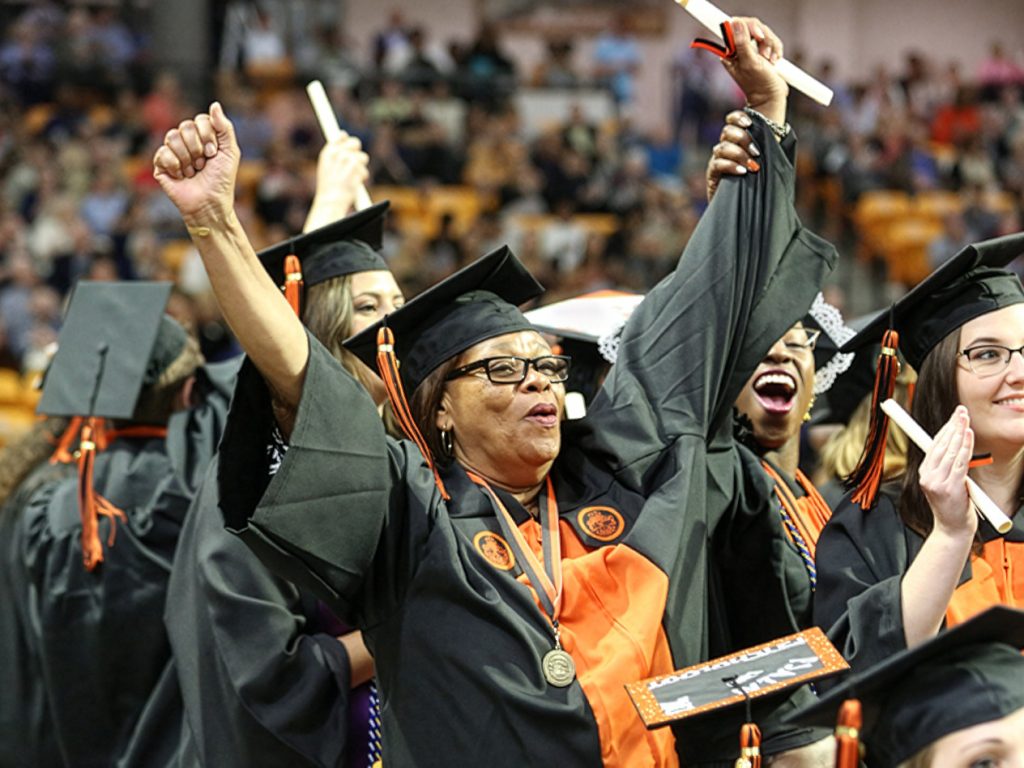

Patricia Oates Conway was a recent high school graduate when she sat outside Campbell College President Norman A. Wiggins’ office in the summer of 1968 as her high school counselor made a case for her to become the school’s first Black female student. When Wiggins asked her counselor what the young lady had to offer the school, his response was, “A better question: What can Campbell do for her?”
Conway would join Marquriette Lawrence that fall as trailblazers, a full semester after Cordell Wise became the school’s first to break the color barrier. And while her first attempt didn’t end the way she’d planned — she left after two years for the “bright lights of Baltimore,” as she put it — she returned to Campbell University over 40 years later to finish the job, earning her degree in communication studies in May 2017, and finally closing the book on an important piece of Campbell history.
Conway died on Sept. 3 in her hometown of Clinton. She was 76.
Answering Wiggins’ initial question, Conway did have something to offer Campbell — her voice. A music major, she joined the travelling choir as a freshman and built strong friendships in the previously all-white group. She once said she had several positive memories of her concert trips and the friendships she made in her group.
But being a trailblazer didn’t come without a price. She endured racial slurs and was once refused service in a restaurant because she was sharing a booth with a fellow male student who was white — the waitress thought they were a couple.
“Those experiences … they changed my whole scope of things,” she said in 2017. “It happens enough times, it does something to you. I became more militant-minded. I’d see people looking side-eyed at me at church, and I handled it, because I was raised in a home of confidence. But part of me was always deciphering why people were like this.”
The stress and the workload — difficult classes and a busy choir schedule — eventually became too much, and Conway left Campbell midway through her third year to move to Baltimore with her aunt and uncle. Work, marriage, three children and a separation marked her 20 years in the city, and in the late 1980s, she returned to North Carolina to be near family. All three of her children went to college, and as adults, they began to encourage Conway to return.
But it took a chance meeting with the man who introduced her to Campbell the first time — her counselor, the Rev. Roger White (a Campbell alumnus) — to seal the deal.
“I was working at Walmart at the time, and I felt a presence behind me. It was the Rev. Roger White,” she said. “We hadn’t seen each other in years, and not long after we exchanged pleasantries, he came out with, ‘When are you going back to Campbell?’ I answered, ‘Why? Am I supposed to?’ He said I needed to do it. ‘They owe you an education,’ he said.”
Earlier that year, Conway lost her oldest son, Gary, who was 35. Before his death, Gary had also encouraged her to return to school, saying she was going to write a book one day.
“I was standing at the edge of a cliff, looking over it, and there was no bottom,” Conway said in 2017. “I knew I had to take the leap, though. So I leapt. Four years later, I’m ready to run.”
Conway is survived by her mother, four sisters, two brothers, two children and one grandchild.