


Great leaders don’t try to do it all themselves. Instead, they rely on the strengths of others and encourage collaboration to achieve their desired goals.
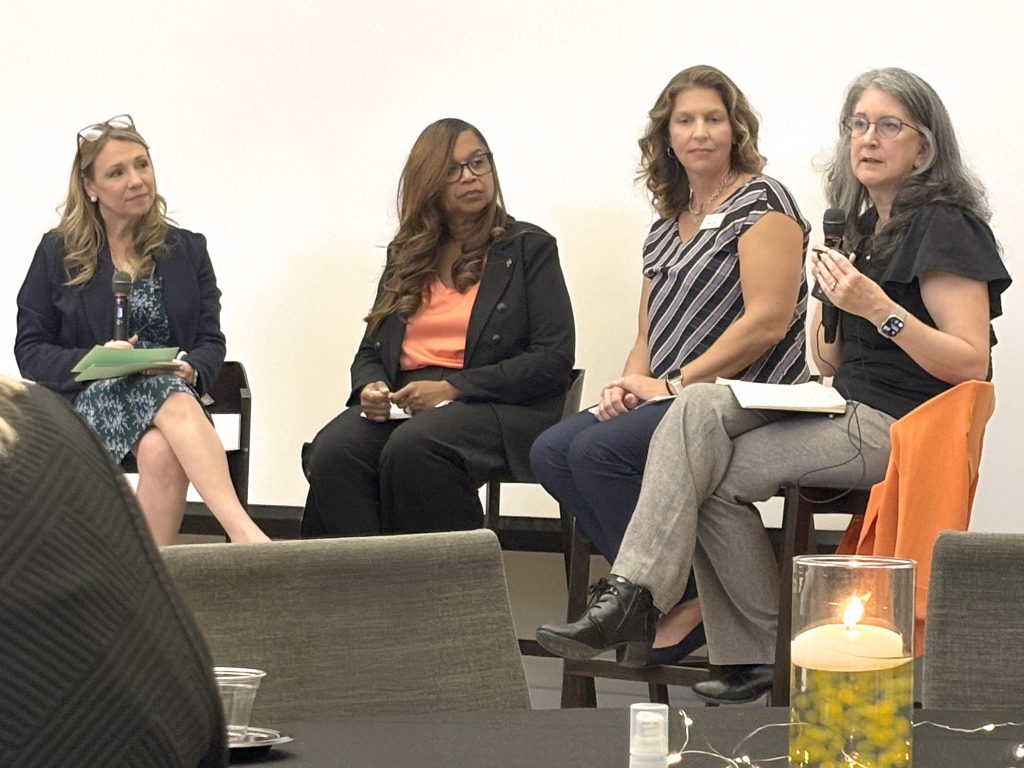
That was a recurring theme of Campbell University’s “Supporting Women in Leadership: Growing Through Connection” panel discussion, held in the Oscar N. Harris Student Union on Wednesday. The talk, hosted by Dr. Brianne Holmes with the School of Osteopathic Medicine, featured three Campbell faculty and staff members who shared their professional journeys and the unique challenges they faced along the way.
“Collaboration isn’t a bad word,” said Azizi Culpepper, a philanthropy officer with the Divinity school and its recently launched Center for Calling & Ministry. “Sometimes in the past, doing things on my own was easier. I felt like I could always hunker down and get it done. But I’ve learned [in higher education] the importance of working with team members and relying on others. It requires a level of vulnerability, and I feel like I’m learning and evolving.”
Associate Dean for Research at the School of Osteopathic Medicine Dr. Terri Hamrick said women (and men) shouldn’t feel the need to “lead by dominance.” Building consensus is a strength many women have, she said, and that strength can go a long way in building effective leadership skills.
“As a leader, you’re only as good as the people you empower,” Hamrick said. “Whether they’re below you in the hierarchical chain, above you or horizontal — there is a lot that I’m not good at, so I try to surround myself with people who can complement what I do.”
Associate Provost for Institutional Effectiveness Maren Hess encouraged the room to have inquisitiveness and tenacity. Being in a leadership role doesn’t mean you’re done learning.
“We have to keep asking, and if you’re too afraid to ask, don’t be afraid to read, and don’t be afraid to test something out,” she said. “None of us are great the first time. None of us are great the fifth time. … Rely on what you are good at, and don’t be afraid to ask questions, because everyone is going to be learning.”
Hess shared her winding journey that began with dreams of earning a doctorate and having a “litany of publications” but was derailed by obstacles, both bad and good.
“I had cancer. I had toddlers (twice). And then family transitions — my boys are in high school, and now we’re getting ready to have my mom move in with us, and she has Alzheimer’s,” Hess said. “So the timing has never been perfect. But I can look at it one way and say I’ve had excuses not to [follow that initial dream]. Or I can look at the other side and say I chose to put my family where it needed to be. My kids needed me. My health needed me. And now my mom needs me. I’m not a keynote speaker at major field events, but I’m making a difference [at Campbell University]. I’m making a difference for our faculty who have access to things that they need and making a difference for our leadership and our academic leadership to be able to see university information that has been less accessible in the past. And I can see the things that have been worked on or I’ve contributed to over time now from the student perspective, because I can see what my son and his friends are experiencing [as they prepare for college].”
The panelists all shared advice they have for future leaders and advice they’ve received that wasn’t so great. For Hamrick, her advice is, “You can do anything, but you can’t do everything.”
“Give yourself the grace to decide what things you will do and and surround yourself with people who can complement what you’re not so strong at,” she said. “And it’s okay to put family first. There are ways to do that and still be successful in your career.”
The bad advice Culpepper received? A co-worker once suggested she was needed at home by her husband more than she was at work. She said her advice to future leaders is avoid comments like that and instead encourage others to succeed.
“If you see a gift in someone, encourage them. Name it. Say it,” she said. “Encourage them with a note, a text. Support them, help to nurture that gift in them. Mentor them. And if you can’t do that, connect them with someone who can.”
Holmes said her goal in hosting the forum was to have women think beyond the titles and promotions when thinking about becoming a leader.
“My hope is that everyone leaves with at least a new connection, an idea or a new perspective,” she said. “I want to reinforce the idea that we are better when we invest in each other’s successes, especially as women. Leadership is built through relationships. It is not a solo endeavor, and it never should be. Collaboration will open the doors for those who are coming behind us.”